Phase 1 Desk Study Cost Guide (2026)
What a Phase 1 desk study costs in 2026, why prices vary so widely between desktop screening and traditional consultancy, and how to tell which approach your site needs.
If you're buying a development site, applying for planning permission, or simply trying to understand what's beneath a piece of land before you commit to it, you'll almost certainly need a Phase 1 desk study. The first question most people ask is: how much does a desk study cost?
The answer varies enormously — and the price you pay depends largely on which approach you choose. In this guide, we break down Phase 1 desk study costs in 2026, explain the different approaches available, and show you how to get the environmental information you need without overspending.
Quick Answer: Phase 1 Desk Study Cost in 2026
- Desktop environmental screening (data-driven): £295–£495
- Traditional Phase 1 consultancy (with site visit): £1,500–£5,000+
- Typical turnaround: 48 hours (desktop) vs. 2–4 weeks (traditional)
The right approach depends on your project stage, the complexity of the site, and what your planning authority or lender requires. In most cases, a desktop screening report is the cost-effective starting point.
What Is a Phase 1 Desk Study?
A Phase 1 desk study — sometimes called a Phase 1 environmental assessment, preliminary risk assessment, or desktop contamination study — is the first stage of environmental due diligence for a development site. It's a Tier 1 desktop assessment that reviews existing data and records to identify potential risks associated with a piece of land.
A typical Phase 1 desk study covers:
- Contamination risk — historical and current land uses that may have left contaminants in the soil or groundwater
- Geology and ground conditions — bedrock type, superficial deposits, made ground, and how these affect foundations
- Groundwater and hydrology — aquifer classifications, source protection zones, and water table considerations
- Historical land use — what the site and surrounding area were used for historically, including former industrial uses, filled ponds, or demolished structures
- Regulatory records — Environment Agency data, local authority records, and any recorded pollution incidents
- Radon and mining risk — whether the site falls within a radon-affected area or former mining zone
The purpose is to identify potential environmental constraints and determine whether further investigation — such as a Phase 2 intrusive site investigation — is needed. In many cases, a well-prepared Phase 1 desk study is all that's required to satisfy planning conditions or lender requirements.
Our geotechnical desk study is one of the most popular reports we deliver through Site Intelligence, our desktop environmental and geotechnical reporting service.
Phase 1 Desk Study Cost Breakdown
The environmental report cost in the UK varies significantly depending on whether you opt for a modern desktop screening approach or a traditional consultancy engagement. Here's how they compare in 2026:
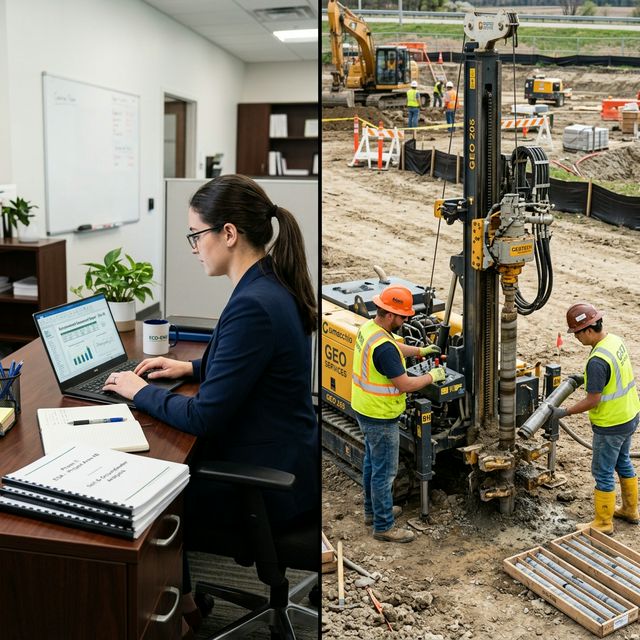
Desktop Environmental Screening: £295–£495
A desktop screening report draws on 60+ environmental, geological, and regulatory data sources to build a comprehensive risk profile of a site — without the need for an initial site visit. This is the approach used by Site Intelligence, and it's the reason the cost is a fraction of traditional consultancy.
At this price point, you typically receive:
- A full desktop contamination and ground conditions assessment
- Historical mapping and land use analysis
- Geology, hydrogeology, and environmental sensitivity review
- Radon risk screening
- Regulatory data search (Environment Agency, BGS, local authority records)
- A clear summary of identified risks and recommended next steps
- Engineering interpretation — not just raw data, but professional analysis of what the data means for your project
Desktop reports are typically delivered within 48 hours. They're particularly well suited to early-stage feasibility, planning applications where a Tier 1 assessment is sufficient, and property purchase due diligence where time is critical.
Traditional Phase 1 Consultancy: £1,500–£5,000+
A traditional Phase 1 desk study from an environmental consultancy involves a site visit, manual data procurement, and a bespoke written report. This approach typically costs between £1,500 and £5,000, depending on the site and the consultancy.
At this price point, you're paying for:
- A physical site walkover and visual inspection
- Manual procurement of Envirocheck or Landmark data
- Bespoke report writing by an environmental consultant
- Peer review and quality assurance
- Consultant travel time and expenses
The traditional approach remains valuable — particularly for complex brownfield sites, sites with known contamination, or projects where a Phase 2 intrusive investigation is likely to follow. But for many straightforward sites, it's more investigation than the project stage requires.
Why the Price Difference?
The cost difference comes down to methodology, not quality. Desktop screening uses data-driven analysis to assess environmental risk efficiently. The data sources are the same — British Geological Survey, Environment Agency, Ordnance Survey historical mapping, local authority records — but the collection and analysis process is streamlined.
Traditional consultancy involves site visits, manual data ordering (which itself carries charges from data providers), and the overhead of a larger team. That's appropriate when the project demands it — but for many sites, it's not the most cost-effective starting point.
What Affects the Cost of a Phase 1 Desk Study?
Whether you choose desktop screening or traditional consultancy, several factors influence the final cost:
Site Size and Complexity
A simple residential plot is quicker and easier to assess than a large mixed-use brownfield site. Larger sites may require more extensive historical research, multiple data searches, and more detailed analysis. Some consultancies price by site area; others use a fixed fee for sites under a certain size with uplift charges for larger plots.
Location
Location affects cost in several ways. Sites in areas with extensive industrial heritage — former mining regions, docklands, or heavy manufacturing zones — typically require more detailed contamination screening. Urban sites in cities like London or Manchester may have more complex historical land uses to untangle.
Additionally, if you're using a traditional consultancy, travel time to remote or rural sites adds to the cost.
Report Type
There's a spectrum of environmental reports. A broad screening report covering contamination, geology, and environmental sensitivity sits at one end. A deep-dive geotechnical assessment with detailed foundation recommendations sits at the other. The more specialist the report, the higher the cost.
Our site feasibility report bundles multiple screening assessments into a single document — covering contamination, ground conditions, flood risk, and planning constraints — which is typically more cost-effective than commissioning each report separately.
Turnaround Time
Urgent reports cost more with traditional consultancies. If you need a report within a week rather than the standard 2–4 week turnaround, expect to pay a premium of 25–50%. Desktop screening reports are less affected by this, as the 48-hour turnaround is the standard rather than a rush service.
Desktop Reports vs. Traditional Consultancy
To help you decide which approach suits your project, here's a side-by-side comparison:
| Factor | Desktop Screening | Traditional Consultancy |
|---|---|---|
| Cost | £295–£495 | £1,500–£5,000+ |
| Turnaround | Typically 48 hours | 2–4 weeks |
| Site visit | No (desktop only) | Yes (walkover inspection) |
| Data sources | 60+ automated data sources | Manually procured data packs |
| Engineering interpretation | Yes | Yes |
| Suitable for planning applications | Yes — for most Tier 1 requirements | Yes — for all requirements |
| Suitable for complex brownfield sites | Good for initial screening | Recommended for detailed assessment |
| Suitable for lender requirements | In most cases, yes | Yes |
| When to use | Early feasibility, planning validation, due diligence, screening before committing to full investigation | Complex sites, known contamination, Phase 2 preparation, sites requiring detailed site-specific assessment |
For a deeper exploration of when each approach is appropriate, see our guide on Phase 1 desk study vs. site investigation.
When Do You Need a Phase 1 Desk Study?
Phase 1 desk studies are required — or strongly recommended — in several common scenarios:
Planning Application Validation
Many local planning authorities (LPAs) in England require a contamination assessment as a validation requirement for planning applications under the Town and Country Planning Act 1990 (TCPA 1990). This is particularly common for:
- New-build residential development
- Change of use to a more sensitive land use (e.g., commercial to residential)
- Sites within or near former industrial areas
- Sites flagged on the local authority's contaminated land register
The National Planning Policy Framework (NPPF) requires that planning decisions ensure development is appropriate for its location, taking account of the effects of pollution on health and the natural environment. A Phase 1 desk study is typically the minimum evidence needed to demonstrate compliance.
Some LPAs will accept a desktop screening report at the validation stage, with conditions for further investigation if the screening identifies potential issues. Others require a full traditional Phase 1 from the outset. It's always worth checking your LPA's validation checklist before commissioning a report.
Property Purchase Due Diligence
If you're purchasing a development site — particularly one with any historical industrial use — a Phase 1 desk study is an essential part of your due diligence. It helps you understand what you're buying before you commit, and can reveal issues that affect the site's value, development cost, or insurability.
Environmental liabilities transfer with the land. If you buy a contaminated site without knowing about the contamination, you inherit the cleanup costs. A desk study costing a few hundred pounds could save you tens of thousands.
Development Feasibility
Before committing to a development project, understanding the ground conditions and environmental constraints helps you build a realistic budget and programme. A Phase 1 desk study at the feasibility stage can flag issues — such as the need for contamination remediation, piled foundations, or specialist drainage — that significantly affect project viability.
This is where desktop screening offers particular value. At £295–£495, you can screen a site before deciding whether to proceed, without committing to the cost of a full traditional investigation.
Mortgage and Lender Requirements
Some mortgage lenders and institutional investors require environmental assessments before approving finance for development projects or commercial property transactions. The level of assessment required varies by lender, but a Phase 1 desk study is typically the minimum expectation.
In most cases, a well-prepared desktop screening report satisfies lender requirements. However, if significant risks are identified, the lender may require a Phase 2 intrusive investigation before releasing funds.
How to Save Money on Environmental Reports
Environmental reporting doesn't have to break the budget. Here are practical ways to manage costs without compromising on the quality of information you receive:
Bundle Your Reports
If you need multiple reports — contamination screening, geotechnical assessment, flood risk assessment — commissioning them together is typically cheaper than ordering each one separately. Bundled reports share common data procurement costs and analysis work, and the provider can pass those savings on to you.
Our site feasibility report is designed precisely for this purpose — it combines multiple screening assessments into a single comprehensive document at a lower cost than commissioning each report individually.
Start with Desktop Screening
Rather than going straight to a full traditional Phase 1, start with a desktop screening report. In many cases, this will be sufficient. If the screening identifies issues that need further investigation, you can then commission a targeted Phase 2 — knowing exactly what you're looking for, rather than paying for a broad-spectrum investigation.
This staged approach — screen first, investigate if needed — is both the most cost-effective and the most technically rational way to manage environmental risk.
Only Escalate When the Desktop Flags Issues
Not every site needs a Phase 2 intrusive investigation. If your Phase 1 desk study concludes that the site has a low risk of contamination and no significant geotechnical concerns, there's typically no need to spend thousands on boreholes and laboratory analysis.
The whole point of the phased approach is to avoid unnecessary investigation. A well-prepared Phase 1 gives you the information to make that decision with confidence.
Commission Early
Leaving environmental reports to the last minute means you'll likely need a rush service — and rush fees add 25–50% to the cost with most traditional consultancies. Commissioning your reports early in the project programme gives you time to use the standard turnaround, which is always cheaper.
With desktop screening from Site Intelligence, the standard turnaround is typically 48 hours — so timing pressure is less of an issue. But even so, having results early helps you plan the rest of the project more effectively.
Frequently Asked Questions
Is a Phase 1 desk study the same as a contaminated land report?
Broadly, yes. A Phase 1 desk study is sometimes called a Phase 1 contaminated land assessment, a preliminary risk assessment (PRA), or a desktop contamination study. The terminology varies between consultancies and planning authorities, but the scope is essentially the same: a desktop review of environmental data to assess contamination risk. Some reports also include geotechnical and geological information, which makes them closer to a combined environmental and geotechnical desk study.
Can I use a desktop report for planning permission?
In most cases, yes. Many local planning authorities accept desktop screening reports as sufficient evidence at the validation stage, particularly for lower-risk sites. Some LPAs may attach a planning condition requiring further investigation if the screening identifies potential issues — but this is a normal part of the planning process and doesn't mean the desktop report was inadequate. We'd always recommend checking your LPA's validation checklist to confirm their specific requirements.
How long is a Phase 1 desk study valid for?
There's no fixed expiry date in legislation. However, most planning authorities and lenders expect environmental reports to be reasonably current — typically no more than 2–3 years old. If significant changes have occurred on or near the site since the report was prepared (new development, demolition, change of use), an updated assessment may be required. Some data sources used in the report, such as Environment Agency records, are updated regularly, so an older report may not reflect current conditions.
Do I need a Phase 1 desk study for a residential extension?
Typically not, unless your property has a specific contamination concern — for example, if it was built on a former industrial site, near a petrol station, or in an area with known ground gas issues. For most standard residential extensions, a desk study isn't required for planning permission or building control. However, if you're adding a basement or significant foundations, a geotechnical desk study may be advisable to understand ground conditions.
What's the difference between Phase 1 and Phase 2?
A Phase 1 desk study is entirely desktop-based — it reviews existing data and records to assess risk. A Phase 2 site investigation involves physical work on site: drilling boreholes, digging trial pits, collecting soil and groundwater samples, and sending them to a laboratory for chemical analysis. Phase 2 is only needed when Phase 1 identifies potential contamination that requires confirmation or quantification. Phase 2 investigations typically cost £3,000–£15,000+ depending on the number of sample locations and laboratory tests required.
Get Your Phase 1 Desk Study
Whether you need a quick desktop screening to inform a purchase decision or a comprehensive environmental assessment for a planning application, Site Intelligence delivers Tier 1 desktop reports from £295 — typically within 48 hours.
We draw on 60+ environmental, geological, and regulatory data sources to provide a thorough desktop assessment of your site. Every report includes engineering interpretation — not just raw data, but professional analysis of what it means for your project.
Contact us to discuss your site, or explore our full range of desktop environmental and geotechnical reports.
This is general guidance only. Every site and project is unique — please contact us for advice specific to your circumstances.
Feasibility Intelligence
Planning-ready intelligence from From £995 — delivered within 48hrs
Ready to get started?
Complete desktop planning intelligence for any site in England. From £199.