How Long Does a Phase 1 Desk Study Take?
How long a Phase 1 desk study takes by route: desktop environmental screening in about 48 hours, traditional consultancy in two to four weeks, and intrusive Phase 2 work longer again.
When you're working to a planning deadline or trying to complete a property purchase, the turnaround time on your environmental report matters as much as its content. A desk study that arrives two days before your submission deadline is far more useful than one that lands two days after.
So how long does a Phase 1 desk study actually take? The answer depends entirely on which approach you use — and the difference is significant.
Quick Answer: Phase 1 Desk Study Turnaround Times
- Desktop environmental screening: Typically 48 hours
- Traditional Phase 1 consultancy: 2–4 weeks
- Phase 2 intrusive investigation: 4–8 weeks
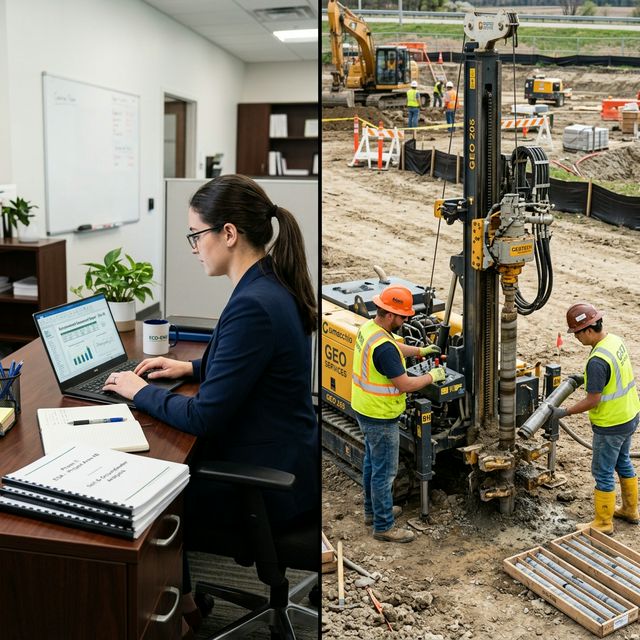
Desktop screening through Site Intelligence typically delivers within 48 hours. Traditional consultancy involving a site visit, manual data procurement, and bespoke report writing takes 2–4 weeks in most cases.
What Determines Turnaround Time?
Several factors influence how long your Phase 1 desk study takes to complete. Understanding these helps you plan your project programme and set realistic expectations.
Report Type and Methodology
This is the biggest factor. A desktop screening report that draws on pre-integrated data sources can be assembled and interpreted far more quickly than a report requiring manual data ordering, a physical site visit, and bespoke narrative writing. The scope of the report also matters — a broad contamination screening is quicker than a combined environmental and geotechnical assessment with detailed foundation recommendations.
Data Availability
Traditional consultancies typically order data packs from third-party providers such as Landmark or Groundsure. These take 2–5 working days to arrive. Environmental data from the Environment Agency, local authority contaminated land records, and historical mapping all have their own procurement timelines. Desktop screening sidesteps this bottleneck by integrating data sources directly.
Consultant Workload
Traditional consultancies have finite capacity. If their geologists and environmental scientists are committed to other projects, your report joins a queue. This is particularly noticeable at busy times of year — spring and early summer tend to be peak periods for environmental consultancy as developers push to get planning applications submitted.
Time of Year
Beyond consultant workload, certain times of year create additional delays. Data providers may have backlogs after bank holidays. Local authority environmental health departments — which some consultancies contact for additional contaminated land information — have their own response times, and these can stretch to several weeks.
Desktop Environmental Reports: Typically 48 Hours
Site Intelligence delivers Tier 1 desktop environmental and geotechnical reports with a typical turnaround of 48 hours. Here's how that's achievable without cutting corners:
Data Collection from 60+ Sources
Rather than ordering data packs from third parties and waiting days for delivery, desktop screening draws on 60+ integrated data sources. These include British Geological Survey records, Environment Agency flood and groundwater data, Ordnance Survey historical mapping, radon risk data, and local authority environmental records. The data is accessed directly and collated as part of the assessment process.
Systematic Analysis
With data available immediately, the analysis can begin straight away. The assessment follows a structured methodology — screening the site against contamination indicators, reviewing geological and hydrogeological conditions, checking regulatory records, and building a conceptual site model. This systematic approach ensures consistency and thoroughness across every report.
Engineering Interpretation
Speed doesn't mean you receive raw data and nothing else. Every report includes professional engineering interpretation — an assessment of what the data means for your specific site and project. You receive clear conclusions on contamination risk, ground conditions, and recommended next steps, written in plain language that you, your architect, or your planning consultant can act on.
This approach works well for cities across England. Whether you're assessing a site in Leeds or Birmingham, the desktop methodology delivers the same quality and speed — there's no travel time or regional availability to factor in.
Traditional Phase 1 Consultancy: 2–4 Weeks
A traditional Phase 1 desk study from an environmental consultancy follows a well-established process, but each step adds time:
Site Visit Scheduling
The consultant needs to arrange a site visit — coordinating their diary, travel logistics, and sometimes site access with the landowner or tenant. Depending on the consultant's workload and the site's location, this alone can take 1–2 weeks to arrange.
Data Procurement
Third-party data packs (Envirocheck, Landmark, GroundSure) typically take 2–5 working days to arrive after ordering. Some consultancies won't begin writing the report until all data packs are received, which means the clock only starts ticking after procurement is complete.
Report Writing and Internal Review
The consultant writes the report, incorporating site visit observations, data pack findings, and their professional assessment. The draft then goes through internal peer review and quality assurance. This process typically takes 3–5 working days, depending on the consultant's workload and the complexity of the site.
Laboratory Analysis (If Applicable)
If the consultancy collects soil or water samples during the site visit (which blurs the line between Phase 1 and Phase 2), laboratory turnaround adds another 5–10 working days. This isn't standard for a Phase 1 desk study, but some consultancies include limited sampling as part of their service.
None of these steps is unnecessary — they're all part of a thorough, traditional assessment. But when time is critical, the cumulative effect can push the total turnaround well beyond the initial estimate.
Timeline Comparison Table
Here's how the main types of environmental and geotechnical assessment compare on turnaround time:
| Assessment Type | Typical Turnaround | What's Included |
|---|---|---|
| Desktop environmental screening | 48 hours | Contamination, geology, groundwater, historical mapping, regulatory data, engineering interpretation |
| Traditional Phase 1 desk study | 2–4 weeks | Site visit, third-party data packs, bespoke report, peer review |
| Phase 2 intrusive investigation | 4–8 weeks | Boreholes, trial pits, soil/water sampling, laboratory analysis, interpretive report |
| Full remediation strategy | 8–16 weeks | Detailed quantitative risk assessment, remediation options appraisal, implementation plan |
As the table shows, there's a clear progression from quick desktop screening through to detailed remediation planning. In most cases, you start at the top and only move down the list if the previous stage identifies issues that require further investigation.
How to Speed Up Your Environmental Report
Regardless of which approach you choose, these steps help ensure you receive your report as quickly as possible:
Start with Desktop Screening
A desktop report in 48 hours gives you immediate visibility of environmental and geotechnical risks. If the screening comes back clean, you may not need a traditional Phase 1 at all. If it flags concerns, you'll know exactly what further investigation is needed — which means the Phase 2 scope is tighter and faster too.
For a full breakdown of costs, see our guide on Phase 1 desk study costs in 2026.
Provide Complete Address Information
This sounds obvious, but incomplete or ambiguous site information is one of the most common causes of delay. Provide the full postal address, postcode, and — if available — the site boundary drawn on a plan. For sites without a postal address (greenfield land, for example), provide coordinates or a clear location description with a site boundary plan. The more precise you are, the quicker the assessment can begin.
Commission Early in the Project
Environmental reports should be one of the first things you commission — not the last. If you wait until two weeks before your planning submission deadline, even a desktop screening report gives you limited time to act on its findings. Commission your desk study at the same time as your other pre-application work, and the results feed naturally into your project programme.
A site feasibility report at the outset of a project — covering contamination, ground conditions, flood risk, and planning constraints in a single document — sets the baseline for all subsequent design and planning decisions.
When Should You Commission a Desk Study?
Timing your environmental report correctly avoids both wasted time and last-minute scrambles. Here's when to commission a desk study relative to common project milestones:
Before a Planning Application
If your local planning authority requires a contamination or ground conditions assessment as a validation requirement, you'll need the report ready before you submit. Under the TCPA 1990 and NPPF, LPAs can refuse to validate applications that don't include required supporting documents. Commission your desk study at least 2–4 weeks before your planned submission date if using traditional consultancy, or at least a week before if using desktop screening (to allow time to review the findings and address any issues).
Before Purchasing a Site
For property purchase due diligence, commission the desk study as early as possible in the transaction process — ideally before you're contractually committed. A 48-hour desktop screening can be turned around within the typical exchange-to-completion window, giving you critical environmental information before you take on liability for the land.
At the Start of Project Planning
The most effective time to commission a desk study is at the very beginning of a project, when you're still assessing feasibility. Environmental and geotechnical findings influence foundation design, drainage strategy, remediation budgets, and sometimes even whether the project is viable at all. Getting this information early means you design around the constraints from the outset, rather than discovering them halfway through the project and having to redesign.
Our geotechnical desk study is specifically designed for this purpose — providing ground condition information early enough to influence design decisions.
Frequently Asked Questions
Can I get a Phase 1 desk study done in 24 hours?
With traditional consultancy, this is very unlikely — the data procurement alone takes 2–5 working days. With desktop screening through Site Intelligence, the standard turnaround is typically 48 hours. Expedited delivery may be possible for straightforward sites — contact us to discuss your specific requirements and timeline.
Does a faster report mean lower quality?
Not at all. The speed of desktop screening comes from methodology — integrated data sources and systematic analysis — not from cutting corners. The data sources used are the same ones traditional consultancies rely on: British Geological Survey, Environment Agency, Ordnance Survey historical mapping, and local authority records. The difference is how the data is collected and processed, not what data is reviewed.
What if the desk study identifies problems — how long do the next steps take?
If your Phase 1 desk study identifies potential contamination or geotechnical concerns that require further investigation, the next step is typically a Phase 2 intrusive site investigation. This involves drilling boreholes, collecting samples, and sending them to a laboratory for analysis. Phase 2 investigations generally take 4–8 weeks from commission to final report. If remediation is then required, a remediation strategy typically takes a further 8–16 weeks to develop. Your desk study report will outline the recommended next steps specific to your site.
How far in advance should I commission a desk study before my planning submission?
We'd recommend allowing at least one week if using desktop screening (48 hours for the report plus time to review and act on findings), or 4–6 weeks if using traditional consultancy. If you suspect your site may have environmental issues — for example, it's on or near former industrial land — allow more time, as the desk study may recommend further investigation that needs to be completed or at least scoped before submission.
Get Your Desk Study Started
Don't let environmental reporting hold up your project. Site Intelligence delivers Tier 1 desktop environmental and geotechnical reports with a typical turnaround of 48 hours — so you get the information you need, when you need it.
Whether you're at the feasibility stage, preparing a planning application, or conducting due diligence on a site purchase, a desktop screening report gives you immediate visibility of the risks and constraints that matter.
Contact us to discuss your site, or explore our full range of desktop environmental and geotechnical reports.
This is general guidance only. Every site and project is unique — please contact us for advice specific to your circumstances.
Feasibility Intelligence
Planning-ready intelligence from From £995 — delivered within 48hrs
Ready to get started?
Complete desktop planning intelligence for any site in England. From £199.