
Every claim, traced and
quality-checked before it reaches you.
A report is only as good as the facts inside it. Here is exactly what happens to a single fact before it appears in yours.
The journey of one fact
Source, automated check, issued brief: the standard on every order, within 48 hours.
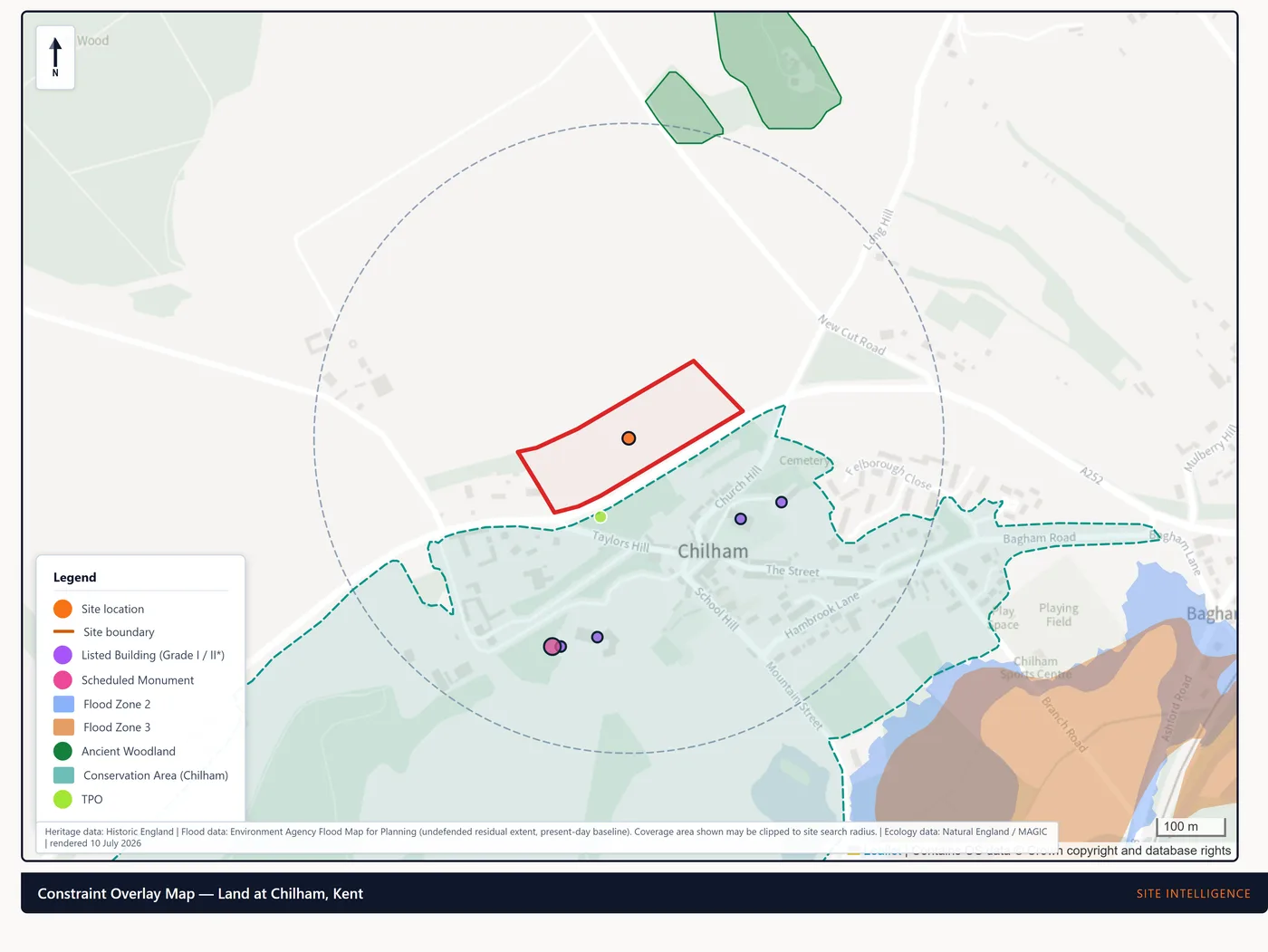
"This site is in a conservation area."
Every statement in a report is a claim that has to be true. We start from the claim, not the conclusion.
Traced to an authoritative dataset
The claim is answered from a named, authoritative source — here, the local planning authority’s conservation-area data and Historic England, not an opinion or a guess.
Cross-checked automatically
Every report runs through 200+ automated checks: source citations, numerical precision, regulatory currency, and consistency against the rest of the report.
Issued within 48 hours
Once every check passes, the brief is issued: a source-traced desktop brief, on your desk within 48 hours. That is the standard on every order.
An expert reads every page
For decisions that warrant extra assurance, add an expert sign-off: a named personal sign-off or a chartered-planner review. The reviewer reads the whole brief and signs the issue sheet, which is why it adds time beyond the 48 hours.
What the 200+ checks cover
The automated checks group into four families. Every brief passes all four before it is issued, as standard.
Accuracy
Source citations, numerical precision and factual claims are checked against the underlying datasets.
Regulatory currency
NPPF and local-plan references are checked against current numbering and dates.
Professional appropriateness
Risk language, recommendations and stated limitations match what the desktop method can defensibly say.
Scope clarity
Where formal surveys, intrusive investigation or specialist sign-off are needed, the report says so plainly.

The expert sign-off, when you want it
Automated quality checks are the standard on every brief. For clients who want a person to have read every page, an optional add-on provides a named personal sign-off or a chartered-planner review. The reviewer reads the whole pack against the checklist below and signs the issue sheet, and that reading time sits outside the 48-hour turnaround.
- Accuracy
- Regulatory currency
- Professional appropriateness
- Scope clarity
Illustrative example of the optional add-on. Site and date redacted; when an expert sign-off is commissioned, the reviewer is named on the sheet.
Developed with reference to the RICS standard on the responsible use of AI before it became mandatory on 9 March 2026. Automation does the heavy lifting on every brief; the expert sign-off is there when you want it.
How we keep it current
Data goes stale and policy moves. These are the guards that stop a confidently-wrong report reaching you.
Source freshness
Each dataset has a refresh window. The checks reject a report if a source is older than its window without a documented exception.
Cross-check against precedent
Risk language is reasoned against 1,000+ verified appeal precedents, so it stays anchored to how inspectors have actually decided similar cases.
Statutory currency
When a policy paragraph or test moves, the affected templates and thresholds are reviewed — so reports track the rules as they change.
Confidence you can check
See the data behind every report, or start with a review of your own site.