Short answer
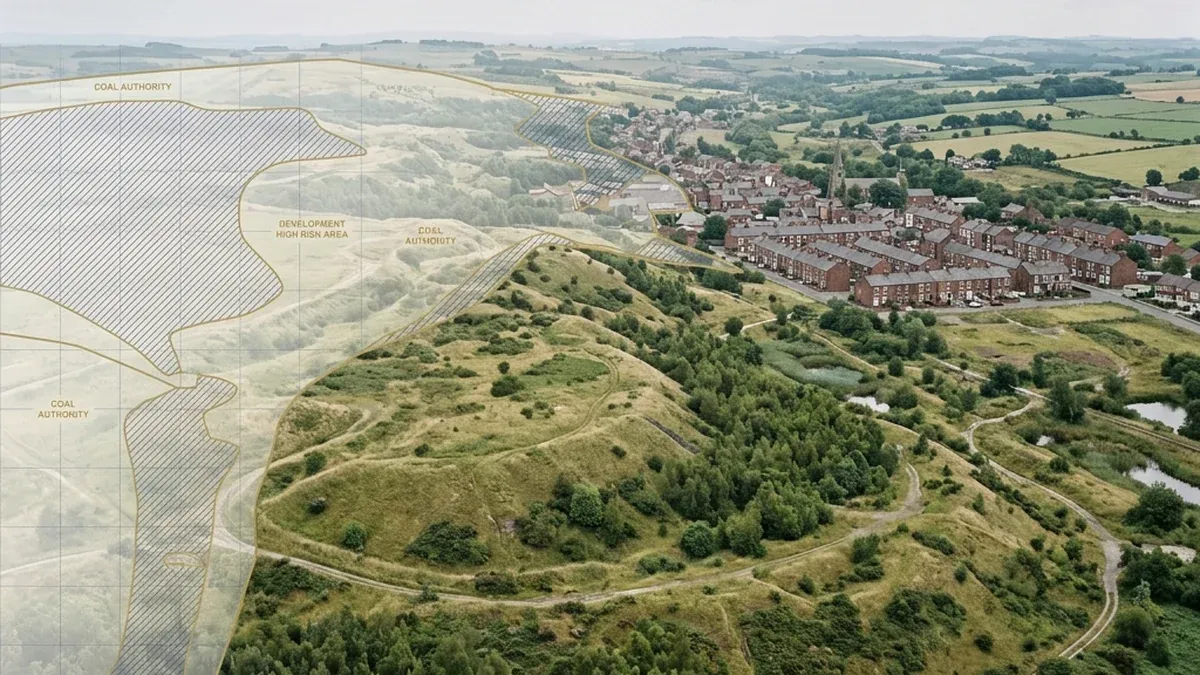
If your site sits in a Coal Authority Development High Risk Area, your planning application will need a Coal Mining Risk Assessment. Without one, the Coal Authority is likely to lodge a holding objection as statutory consultee, and your LPA case officer will hold the application until it is resolved. For a small developer working to a conditional offer, an exchange deadline or a lender milestone, that is weeks of slippage you cannot price in late.
The desktop CMRA identifies recorded and probable mine entries, recorded shallow workings, mine gas potential and surface stability risks, then names the mitigation route and where intrusive work is the next step. We produce it inside Site Appraisal (from £295) for go/no-go calls, and inside the Pre-Application Pack (from £2,250) where it sits alongside Phase 1, FRA, Heritage, Transport and BNG layers. We confirm the delivery date with the scope and the price, before you pay. Sites in Development Low Risk Areas typically do not need a CMRA, though a Coal Authority Mining Report may still be needed for the legal pack at exchange.
Request a Site Appraisal quote or see a sample report.
When a Coal Mining Risk Assessment is triggered
A CMRA is triggered by specific conditions published in GOV.UK Coal Authority guidance on coal mining risk assessments. The conditions are:
- The site is located within a Coal Authority Development High Risk Area.
- Recorded mine entries (shafts or adits) sit within the site boundary or within an influencing distance of proposed structures.
- Recorded shallow coal workings are mapped beneath the site at depths capable of affecting surface stability.
- Recorded fault zones or mine gas vent risk areas intersect the site.
- A historic colliery, gob, slag heap, coal washery or other surface mining feature is recorded on or adjacent to the site.
Coal Authority coverage is Great Britain only. The largest historic footprints sit in Yorkshire, the Midlands, the North East, South Wales and central Scotland. Northern Ireland is outside Coal Authority coverage.
For a small developer, check this before offer, exchange or pre-app
Three decision moments where a desktop screen protects margin:
- Before submitting a conditional offer on a 1-10 dwelling infill site, barn conversion or small estate edge parcel. Confirm whether you are in a Development High Risk Area before you commit to a price the ground cannot support.
- Before exchange on a brownfield plot. Lenders, JV partners and investors want the abnormal ground-treatment exposure quantified, not assumed.
- Before booking a pre-app. Walking in with the CMRA evidence already drafted shortens the route to a positive officer view and avoids a second meeting.
What our desktop CMRA covers
| In our desktop CMRA | Sourced from |
|---|---|
| Development High Risk Area status | Coal Authority Development High Risk Areas dataset |
| Recorded mine entries within and around the site | Coal Authority recorded mine entries dataset (shafts and adits) |
| Probable mine entries from historic record | Coal Authority probable mine entries |
| Recorded shallow coal workings | Coal Authority recorded shallow workings dataset |
| Mine gas vent risk | Coal Authority mine gas dataset |
| Surface stability risk areas | Coal Authority surface hazards dataset |
| Historic colliery and tip locations | Historic Ordnance Survey and Coal Authority records |
| Indicative seam depth and worked status | British Geological Survey (BGS) and Coal Authority interpreted records |
| Influencing distance and likely treatment zones | Combined geometry analysis |
| CMRA scope and intrusive investigation trigger | Combined judgment per Coal Authority guidance |
The desktop CMRA gives you the planning-stage evidence layer the Coal Authority looks for as statutory consultee. Where intrusive investigation is needed, the report names the indicative scope, cost range and typical timeline. See what is included in our desktop pack for the full layer list.
What this desktop CMRA does not replace
The desktop layer is the planning-stage screen. It is not:
- A rotary bore investigation through worked coal seams (typically £8,000 to £25,000 by a chartered geo-environmental or mining engineer).
- Mine entry inspection and treatment design (capping, grouting, void infill).
- A chartered mining engineer's signed CMRA, where formal reliance is required by Building Control or NHBC.
- Foundation engineering for sites over recorded shallow workings.
- On-site mine gas monitoring.
- Long-term mine water rebound monitoring.
- The Coal Authority Mining Report, which is the legal pack search document. The Mining Report and a CMRA answer different questions, and the Mining Report is not always needed alongside a CMRA at the planning stage.
Where any of these are triggered, the report names the specialist study, indicative cost range and typical timeline.
Four packs sized to four decisions
| Pack | What it does for coal mining risk | Decision moment | Price |
|---|---|---|---|
| Site Appraisal | Identifies Development High Risk Area status, mine entries, shallow workings | Bid or pre-screening | From £295 |
| Feasibility Intelligence | Adds abnormal cost provision for intrusive investigation, treatment and foundation engineering | Pre-acquisition or pre-architect | From £995 |
| Pre-Application Pack | Adds the full desktop CMRA evidence section, ready for the Coal Authority statutory consultee response | Pre-app meeting booked | From £2,250 |
| Consultant Handover Pack | Submission-ready CMRA alongside specialist intrusive investigation where commissioned | Application submission | Tailored |
Which pack should I choose? Site Appraisal if you are still bidding and need a go/no-go before committing capital. Feasibility Intelligence if you are pre-acquisition and need the abnormal-cost line for the bid model or lender. Pre-Application Pack if your pre-app is booked and you want the CMRA evidence drafted. Consultant Handover Pack if you are at submission and need the CMRA aligned with intrusive findings. For wider planning context, see our guide on what reports you need for planning permission and the auction site due diligence guide.
Send the boundary today
Send postcode, red-line boundary, intended use and indicative dwelling count. We confirm the scope, the price and the delivery date before you pay. You receive the constraint screen with Development High Risk Area status, mine entry locations and intrusive investigation cost provision.
From £295 to find out before you bid whether a shaft sits inside the red line. From £995 to put the abnormal ground-treatment cost into the offer model. From £2,250 to walk into pre-app with the CMRA evidence section drafted. Tailored where the application needs to land alongside intrusive investigation and treatment strategy.
For wider planning context, see GOV.UK planning permission guidance and our mega-pillar guide on what reports you need for planning permission.