Planning & Regulation Mar 17, 2026 13 min read
Biodiversity Net Gain Explained: What Developers Need to Know (2026)
Biodiversity net gain has been mandatory in England since February 2024. Where the regime stands now, plus exemptions and metric changes expected in 2026.
Biodiversity net gain (BNG) has fundamentally changed how development and nature interact in England. Since becoming mandatory in February 2024, BNG has reshaped the planning process for housing, commercial, and infrastructure projects of all sizes. Two years on, the framework continues to evolve -- with new exemptions, updated metrics, and the extension of BNG to nationally significant infrastructure projects all on the horizon for 2026.
Whether you are a housebuilder submitting your first application under the new rules, a landowner exploring development potential, or a planning consultant advising clients, this guide sets out everything you need to know about biodiversity net gain as the regime stands today.
What Is Biodiversity Net Gain?
Biodiversity net gain is a planning requirement that ensures development leaves the natural environment in a measurably better state than before. After a development is completed, there must be more or higher-quality natural habitat than existed on the site prior to construction.
Rather than simply protecting what is already there, BNG requires developers to actively enhance biodiversity -- creating new habitats, improving degraded ones, or funding habitat creation elsewhere. Voluntary offsetting schemes operated in parts of England for over a decade, but in 2024, BNG became a legal obligation under the Environment Act 2021, embedded in the National Planning Policy Framework (NPPF).
The Legal Framework: Environment Act 2021 and NPPF
The statutory basis for mandatory BNG is Schedule 7A of the Town and Country Planning Act 1990, inserted by Schedule 14 of the Environment Act 2021. This introduced the general biodiversity gain condition, automatically applied to every qualifying planning permission in England.
The NPPF reinforces this through key paragraphs. Paragraph 180(d) directs that planning decisions should secure "measurable net gains for biodiversity." Paragraphs 187, 192, and 193 set the wider policy context, including the mitigation hierarchy (avoid, mitigate, compensate) and protection of irreplaceable habitats. Together, these provisions mandate a minimum 10% biodiversity net gain, measured using the statutory biodiversity metric.
The Mandatory 10% Requirement
The headline figure is straightforward: developers must demonstrate that their project will result in at least a 10% uplift in biodiversity value compared to the pre-development baseline. This is not a target or aspiration -- it is a binding legal requirement.
The 10% figure is a floor, not a ceiling. Some local planning authorities have adopted policies requiring higher percentages -- 15% or even 20% -- through their local plans. Developers should always check the specific requirements of the relevant LPA before progressing a scheme.
How Is Biodiversity Value Measured?
Biodiversity value is quantified in biodiversity units, calculated using the statutory biodiversity metric published by the Department for Environment, Food and Rural Affairs (Defra). The current statutory metric is based on the earlier Biodiversity Metric 4.0, with minor updates for clarity and additional guidance on specific habitat types such as watercourses.
The metric assesses three categories of biodiversity units:
• Area-based habitat units (for terrestrial habitats such as grassland, woodland, and scrub)
• Hedgerow units (for linear hedgerow features)
• Watercourse units (for rivers, streams, ditches, and canals)
• Hedgerow units (for linear hedgerow features)
• Watercourse units (for rivers, streams, ditches, and canals)
Each habitat parcel is scored based on its size, distinctiveness (ecological value), condition, strategic significance (alignment with Local Nature Recovery Strategies), and connectivity. The metric calculation produces a baseline score for the pre-development site and a projected post-development score, allowing a direct comparison.
You must use the statutory biodiversity metric tool for mandatory BNG calculations. Earlier versions of the metric (including Metric 4.0) are no longer accepted for planning applications. The calculation tool is freely available from GOV.UK.
Who Does BNG Apply To?
The Rollout Timeline
BNG was introduced in two phases:
• 12 February 2024: Mandatory for all major developments (10 or more dwellings, or sites of 1 hectare or more, or 1,000 square metres or more of new floor space)
• 2 April 2024: Extended to small sites (1-9 dwellings on sites under 1 hectare, or sites under 0.5 hectares where dwelling numbers are unknown)
• 2 April 2024: Extended to small sites (1-9 dwellings on sites under 1 hectare, or sites under 0.5 hectares where dwelling numbers are unknown)
As of April 2024, the requirement applies to the vast majority of planning applications in England that involve any loss or disturbance of habitat.
What About Nationally Significant Infrastructure Projects?
Nationally significant infrastructure projects (NSIPs) -- such as major power stations, strategic road schemes, and large-scale wind farms -- were initially outside the scope of mandatory BNG. The government has confirmed that BNG will become mandatory for NSIPs from May 2026, following a consultation response published alongside updated NSIP-specific guidance.
Exemptions: What Is and Is Not Covered
Not every development triggers the BNG requirement. Key exemptions include:
• De minimis exemption: Developments that affect less than 25 square metres of on-site habitat with a biodiversity value greater than zero are exempt. This covers genuinely minor works with negligible ecological impact.
• Permitted development: Most development carried out under permitted development rights (where full planning permission is not required) is exempt.
• Householder applications: Extensions and alterations to existing dwellings are generally exempt.
• Self-build and custom-build: Certain self-build developments are exempt, subject to conditions.
• Irreplaceable habitats: Where development affects irreplaceable habitats (such as ancient woodland), a separate bespoke compensation approach applies rather than the standard metric.
• Permitted development: Most development carried out under permitted development rights (where full planning permission is not required) is exempt.
• Householder applications: Extensions and alterations to existing dwellings are generally exempt.
• Self-build and custom-build: Certain self-build developments are exempt, subject to conditions.
• Irreplaceable habitats: Where development affects irreplaceable habitats (such as ancient woodland), a separate bespoke compensation approach applies rather than the standard metric.
The Small Sites Story: From Exemption to Inclusion -- and Back Again
When BNG first became mandatory in February 2024, small sites were temporarily exempt. That exemption ended on 2 April 2024, bringing small developments fully within scope.
However, recognising the disproportionate administrative burden on very small schemes, the Housing Secretary announced in December 2025 a new area-based exemption for sites under 0.2 hectares. Secondary legislation is expected in the first half of 2026. The government is also consulting on a further exemption for residential brownfield development on sites up to 2.5 hectares of lower ecological value, with a response expected mid-2026.
These changes reflect the balancing act between environmental ambition and the practical realities of housing delivery.
On-Site, Off-Site, and Statutory Credits: The Three Delivery Routes
The legislation establishes a clear hierarchy for how the 10% gain should be delivered:
1. On-Site Habitat Creation and Enhancement (Preferred)
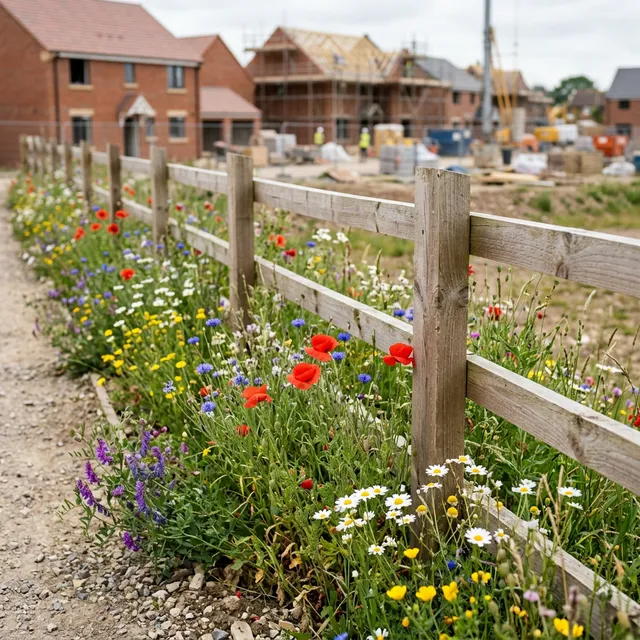
The default expectation is that biodiversity gains are delivered on the development site itself -- wildflower meadows, native hedgerows, green roofs, enhanced woodland, or ecologically valuable sustainable drainage. On-site delivery is preferred because it provides direct local benefits and is often the most cost-effective approach.
2. Off-Site Habitat Creation (Secondary Option)
Where on-site delivery is not feasible or cannot achieve the full 10%, developers can secure off-site biodiversity units. This is done either by:
• Creating or enhancing habitat on other land controlled by the developer
• Purchasing off-site biodiversity units from a registered habitat bank -- a site where a landowner has created or enhanced habitat specifically for the purpose of selling biodiversity units
• Purchasing off-site biodiversity units from a registered habitat bank -- a site where a landowner has created or enhanced habitat specifically for the purpose of selling biodiversity units
Off-site gains must be registered on the national BNG register and secured through a legal agreement (a conservation covenant or Section 106 agreement) lasting at least 30 years.
The market for off-site units has developed rapidly since 2024. Current market prices typically range from approximately GBP 20,000 to GBP 25,000 per biodiversity unit, though prices vary significantly depending on habitat type, location, and strategic significance.
3. Statutory Biodiversity Credits (Last Resort)
As a final option, developers can purchase statutory biodiversity credits from the government, intentionally priced at a significant premium to incentivise genuine habitat creation. The base price for a low-distinctiveness credit is approximately GBP 42,000 -- but because of the spatial risk multiplier (each credit represents only half a biodiversity unit), the effective cost is roughly GBP 84,000 per unit. For higher-distinctiveness habitats, costs can exceed GBP 1 million per unit. The government's first annual report (February 2024 to February 2025) recorded total credit sales of just GBP 206,180, confirming that credits are genuinely a last resort.
The 30-Year Maintenance Period
One of the most significant (and frequently underestimated) aspects of BNG is the 30-year habitat management and maintenance obligation. This is not a planning condition that can be discharged after a few years -- it is a legally binding commitment.
What Does This Involve?
Every qualifying development must be supported by a Habitat Management and Monitoring Plan (HMMP). This document, typically prepared by a qualified ecologist, sets out:
• How retained, created, or enhanced habitats will be managed over the 30-year period
• A monitoring schedule, with regular assessments to check whether habitats are achieving their target condition
• Adaptive management measures if habitats are underperforming
• Responsibilities for ongoing maintenance (including who will carry it out and how it will be funded)
• A monitoring schedule, with regular assessments to check whether habitats are achieving their target condition
• Adaptive management measures if habitats are underperforming
• Responsibilities for ongoing maintenance (including who will carry it out and how it will be funded)
The HMMP is secured through either a Section 106 agreement with the local planning authority or a conservation covenant with a designated responsible body.
Practical Implications
Management and monitoring must be funded for the full 30-year period, factored into the scheme's viability assessment from the outset. For residential schemes, ongoing management is often passed to a management company with costs recovered through service charges. For commercial developments, the obligation typically sits with the landowner or occupier. Failure to maintain habitats in accordance with the HMMP can result in enforcement action.
How to Plan for BNG Early
The single most important piece of advice for any developer considering a new project is this: engage with BNG as early as possible. Retrofitting BNG compliance into a scheme that was designed without it in mind is far more expensive and disruptive than integrating it from the start.
Step 1: Understand Your Baseline
Before design work begins, commission a preliminary ecological appraisal (PEA) and baseline habitat survey. This establishes the site's current biodiversity value -- the number against which the 10% uplift will be measured.
Early baseline work also protects against a common risk: if habitat is cleared or degraded before the planning application, the LPA will use the pre-degradation baseline. The "baseline fixing" rules prevent gaming of the system.
An early-stage screening assessment -- such as Site Intelligence's BNG Screening Report -- can provide rapid initial understanding of a site's biodiversity constraints and opportunities, informing feasibility decisions before significant design costs are incurred.
Step 2: Design With BNG in Mind
Work with your design team and ecologist to incorporate biodiversity into the scheme from the outset. This might mean adjusting layout to retain a mature hedgerow, incorporating a green corridor, or designing sustainable drainage that doubles as wetland habitat. Early integration is almost always cheaper than bolt-on solutions.
Step 3: Run the Metric Early
Do not wait until the planning application is being finalised to run the statutory biodiversity metric. An early metric calculation will reveal whether the scheme can achieve 10% on-site, or whether off-site units will be needed. This avoids last-minute scrambles to source units and the risk of cost overruns.
Step 4: Secure Off-Site Units in Advance
If off-site units are needed, start sourcing them early. The market is still maturing, and availability -- particularly units aligned with the Local Nature Recovery Strategy -- can be limited. Leaving this to the last minute is a common cause of planning delays.
Step 5: Budget for the Full 30 Years
Factor 30-year management and monitoring costs into your scheme appraisal. These are legally required, not optional extras, and for larger schemes the cumulative cost can be substantial.
Common Pitfalls
Having worked through two years of mandatory BNG, clear patterns have emerged in what trips developers up. Here are the most frequent mistakes:
1. Claiming Exemptions Incorrectly
In the early months of mandatory BNG, over 75% of applications initially claimed an exemption -- many incorrectly. Misinterpreting exemption criteria can lead to validation failure or refusal. Always document your exemption status carefully.
2. Submitting Inadequate Documentation
Most LPAs now expect a draft biodiversity gain plan at the validation stage, including baseline data, proposed uplift, and a completed statutory metric calculation. Applications without this information are increasingly returned as invalid.
3. Underestimating Off-Site Unit Costs
Developers who have not budgeted for off-site units can face unexpected bills of tens of thousands of pounds. Early engagement with the metric and the off-site market is essential.
4. Ignoring Local Authority Policies
The national minimum is 10%, but some LPAs require 15% or 20% through local plan policies, or have specific habitat requirements linked to their Local Nature Recovery Strategy. Check local policy early.
5. Late Engagement With Ecology
Bringing an ecologist on board at the application stage is too late. Baseline surveys must be conducted at the right time of year (many are seasonally constrained), and habitat design needs to be integrated from concept stage.
6. Failing to Account for Irreplaceable Habitats
If the site contains irreplaceable habitats -- ancient woodland, ancient hedgerows, certain priority habitats -- the standard metric does not apply. A bespoke compensation approach is required, and planning policy strongly discourages any loss.
Cost Implications for Developers
BNG adds cost to development, but the scale varies enormously. For a straightforward scheme on a site with low existing biodiversity value, achieving 10% on-site may be modest -- incorporated into the landscaping budget. Where on-site delivery is difficult, purchasing off-site units at GBP 20,000-25,000 per unit adds significant sums. Statutory credits at GBP 84,000+ per unit are deliberately punitive to encourage genuine habitat creation.
Beyond habitat creation and unit purchase, developers should budget for:
• Ecological surveys and metric calculations (typically GBP 2,000-10,000 depending on site complexity)
• Habitat Management and Monitoring Plan preparation (GBP 2,000-5,000)
• 30-year management and monitoring costs (variable, but potentially GBP 50,000-200,000+ for larger schemes)
• Legal costs for Section 106 agreements or conservation covenants
• Habitat Management and Monitoring Plan preparation (GBP 2,000-5,000)
• 30-year management and monitoring costs (variable, but potentially GBP 50,000-200,000+ for larger schemes)
• Legal costs for Section 106 agreements or conservation covenants
Early planning dramatically reduces BNG costs. Schemes designed with BNG in mind from the outset consistently achieve compliance at lower cost than those where BNG is treated as an afterthought.
Looking Ahead: What Is Changing in 2026?
Several significant developments are expected through 2026:
• NSIPs: BNG becomes mandatory for nationally significant infrastructure projects from May 2026, expanding the regime's scope substantially.
• 0.2-hectare exemption: Secondary legislation for the area-based exemption (sites under 0.2 hectares) is expected in the first half of 2026.
• Brownfield consultation: A targeted brownfield exemption (residential brownfield sites up to 2.5 hectares) is under consultation, with a response expected mid-2026.
• Metric updates: Routine refinements to the statutory biodiversity metric continue, focused on clarification rather than fundamental methodology changes.
• Market maturation: The off-site unit market continues to grow, with increasing availability of registered habitat banks and greater price transparency.
• 0.2-hectare exemption: Secondary legislation for the area-based exemption (sites under 0.2 hectares) is expected in the first half of 2026.
• Brownfield consultation: A targeted brownfield exemption (residential brownfield sites up to 2.5 hectares) is under consultation, with a response expected mid-2026.
• Metric updates: Routine refinements to the statutory biodiversity metric continue, focused on clarification rather than fundamental methodology changes.
• Market maturation: The off-site unit market continues to grow, with increasing availability of registered habitat banks and greater price transparency.
Developers and landowners should monitor these changes closely, particularly the new exemptions, which could materially affect scheme viability for smaller projects.
Frequently Asked Questions
What is the 10% biodiversity net gain requirement?
All qualifying developments in England must deliver a minimum 10% uplift in biodiversity value compared to the pre-development baseline, as required by the Environment Act 2021. This is calculated using the statutory biodiversity metric, which measures biodiversity in standardised units based on habitat type, condition, size, and strategic significance. Some local authorities require a higher percentage through their local plan policies.
Does BNG apply to small developments?
Yes. Since 2 April 2024, BNG has applied to small sites (1-9 dwellings on sites under 1 hectare). However, in December 2025, the government announced a new area-based exemption for developments on sites under 0.2 hectares, which is expected to be implemented through secondary legislation in the first half of 2026. Householder applications (extensions and alterations to existing homes) remain exempt, as do developments affecting less than 25 square metres of habitat.
How long do habitats need to be maintained?
All habitat created or enhanced under BNG must be managed and maintained for a minimum of 30 years from completion. This is secured through a Section 106 agreement or conservation covenant and must be supported by a Habitat Management and Monitoring Plan (HMMP) covering management prescriptions, monitoring schedules, and adaptive management measures.
What happens if I cannot achieve 10% on-site?
The legislation provides a hierarchy: on-site delivery first, then off-site units, and finally statutory credits. You can purchase off-site biodiversity units from a registered habitat bank (typically GBP 20,000-25,000 per unit) or, as a last resort, buy statutory credits (approximately GBP 42,000 per credit, equating to roughly GBP 84,000 per biodiversity unit due to the spatial risk multiplier).
When do I need to submit my biodiversity gain plan?
The biodiversity gain plan is technically a pre-commencement condition -- it must be submitted and approved by the local planning authority before development can begin. However, most LPAs now expect a draft plan (including a completed statutory metric calculation) at the validation stage alongside the planning application. Submitting this information early reduces the risk of delays and validation problems.
Can the pre-development baseline be manipulated?
The regulations include safeguards against this. If habitat on a site has been degraded or cleared in the period before a planning application is submitted, the local planning authority can use the earlier, higher biodiversity value as the baseline for the metric calculation. This means that clearing vegetation to reduce the baseline score is not only unethical but counterproductive -- it can result in a higher BNG obligation.
Get Ahead of BNG Requirements
Understanding your site's biodiversity position early is the most effective way to manage BNG risk and cost. A clear picture of existing habitats, constraints, and likely metric outcomes puts you in control of the process.
Site Intelligence's BNG Screening Report provides a rapid, AI-accelerated desktop assessment of your site's biodiversity context, giving developers and landowners the early intelligence they need to plan with confidence.
This article was last updated in March 2026. Biodiversity net gain policy continues to evolve, and developers should verify current requirements with their local planning authority and professional advisers before submitting planning applications.
Related Report
Feasibility Intelligence
Planning-ready intelligence: From £995
Ready to get started?
Complete desktop planning intelligence for any site in England. From £295.