Guide May 1, 2026 10 min read
Grey Belt Site Check: Is Your Land Eligible? (2026 UK Developer Guide)
Grey belt eligibility: the four NPPF tests your land must pass, how approval rates look 18 months on, and the failure mode behind most refusals.
Grey belt was the most consequential planning policy change of 2024. The Labour government added the category to the NPPF in December 2024 to release Green Belt land that does not strongly contribute to the five Green Belt purposes, easing the housing land supply problem without rewriting the Green Belt itself.
Eighteen months in, the picture is mixed. Approval rates on grey belt schemes are higher than the Green Belt average but lower than headline coverage suggests. The four-part NPPF test is being applied unevenly across LPAs, and most refusals trace to one specific failure mode that developers can pre-screen at desktop stage.
This guide covers what grey belt actually is, the four tests a site must pass, what we are seeing on approval rates by LPA, and how to do a desktop grey belt check before you commit to a planning consultant.
What grey belt is, and what it is not
Grey belt is Green Belt land that meets two conditions. First, it is previously-developed land within the Green Belt, or land that does not strongly contribute to Green Belt purposes (a) preventing urban sprawl, (b) preventing neighbouring towns merging, or (d) preserving the setting and special character of historic towns. Second, releasing it for development would not fundamentally undermine the remaining Green Belt.
Crucially, grey belt is not a separate designation. There is no map. There is no formal grey belt boundary. Each site is assessed against the criteria when a planning application or local plan review is determined. That means a site is "grey belt" only when an LPA or inspector decides it is, on the evidence the applicant submits.
It is also not a guarantee of approval. The grey belt provisions in NPPF paragraph 155 introduce three "golden rules" for major housing schemes on grey belt land. First, affordable housing at 15 percentage points above the highest applicable local plan target, capped at a maximum of 50%. Second, infrastructure provision proportionate to scheme scale. Third, accessible new or improved green spaces for residents and the wider community. Failure on any of these can refuse a scheme even if the land qualifies as grey belt.
The grey belt tests in NPPF paragraphs 154 and 155
NPPF paragraph 154 (December 2024) defines grey belt land. Paragraph 155 sets the conditions for releasing it for major development. We treat these as four practical tests applicants must satisfy. The framing is a teaching device; the underlying policy is what matters and you should reference the actual paragraph numbers in any planning submission.
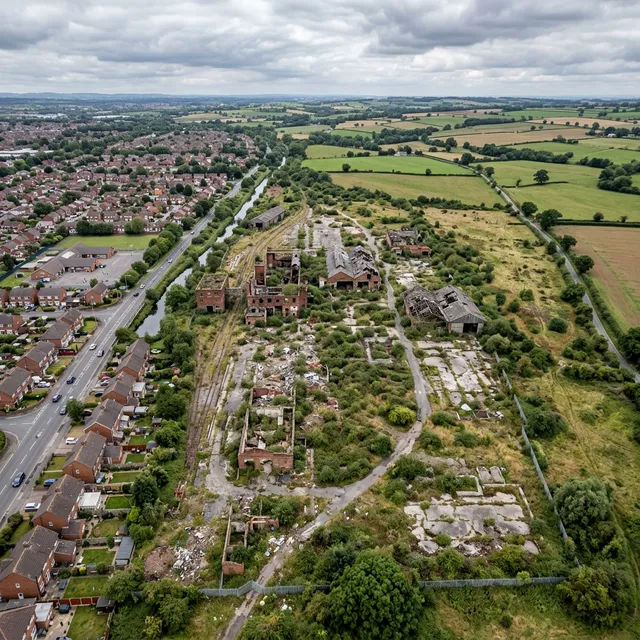
Test 1: Is the site grey belt? (paragraph 154) Either previously-developed (PDL within the Green Belt, common with disused commercial yards, redundant agricultural buildings, former petrol stations), or land that makes a limited contribution to Green Belt purposes (a) preventing urban sprawl, (b) preventing neighbouring towns merging, and (d) preserving the setting and special character of historic towns. Most failures here come from sites that are open countryside in agricultural use, near the urban edge but with open aspect onto the wider countryside. These typically still contribute to purpose (a) preventing sprawl.
Test 2: Does release fundamentally undermine the remaining Green Belt? (paragraph 155) The test is qualitative. The inspector or planning officer asks whether removing this site materially weakens the function of the broader Green Belt parcel. Small infill releases on the urban edge are usually fine. Significant releases that fragment a large open parcel are usually not.
Test 3: Demonstrable unmet housing need. The LPA must be unable to demonstrate a five-year housing land supply, or the relevant Housing Delivery Test reading must show a delivery shortfall. The Housing Delivery Test pathway is increasingly the more common route after the November 2024 transitional arrangements. Some LPAs in rural Lancashire, parts of West Yorkshire and parts of the South West currently meet supply, so this test is harder to satisfy there.
Test 4: Sustainable location. The site must be reasonably accessible to services and amenities. Inspectors look at the totality of accessibility rather than a single factor — a site with weaker bus access but strong walkable amenities can pass; a site reliant entirely on private car use rarely does. Test 4 is the most subjective of the four and the place where well-evidenced applications can recover ground that desktop indicators suggest they would lose.
A site that fails any one test is unlikely to succeed via the grey belt route. There is no formal balancing exercise across the four.
What approval data tells us so far
Grey belt has only been in NPPF since December 2024, so the published evidence base is still thin. The most useful current reference is the Marrons Grey Belt Decision Tracker, which maintains a running list of determined applications and appeals. Lichfields published an analysis in March 2025 showing approximately 36% of grey belt housing appeals allowed at that point.
Patterns visible in the published decisions so far:
Larger promoter-backed schemes (50+ dwellings) are doing better than small schemes. They are more carefully prepared, more often fall on land where supply is weak, and more often pass the three golden rules cleanly.
Householder-scale grey belt applications (single dwellings, infill on PDL) struggle more often. The golden rules are designed for major schemes (10+ dwellings) so they do not apply directly, but small sites still fail Test 4 (sustainable location) at a higher rate.
Of the appeal refusals tracked, the most common refusal grounds are failure on Test 4 (sustainable location), failure on the affordable housing golden rule on viability arguments, and failure on Test 1 (the site does not qualify as grey belt under paragraph 154 because it still contributes meaningfully to Green Belt purposes a or b).
These are observed patterns, not statistics. Treat them as a directional signal until a meaningful body of determinations builds up.
The four most common reasons grey belt sites fail
These are not formal tests but practical patterns from determined applications.
1. Open countryside positioning. The site is on the urban edge but the field beyond it is open all the way to the next settlement. The inspector reads it as still contributing to Green Belt purpose (a). Even with strong Test 4 evidence, the site does not get past Test 1.
2. Affordable housing percentage shortfall. The applicant proposes the same affordable housing share as the local plan policy demands. The grey belt golden rule requires 15 percentage points above the local target, capped at 50%. So if the local plan asks for 35%, the grey belt scheme must deliver 50%. If the local plan asks for 25%, the grey belt scheme must deliver 40%. Viability arguments to reduce below the +15pp threshold rarely succeed in the early grey belt determinations because the policy only landed in December 2024 and inspectors are reading paragraph 155 strictly.
3. Public transport thinness. The site is "near a bus stop" but the bus runs every hour, terminates 4 miles away, and does not connect to a main employment centre. Test 4 fails. Adding a developer-funded shuttle does not fix this in the eyes of most inspectors.
4. Heritage and ecology constraints under-evidenced. Grey belt eligibility does not switch off other planning considerations. A site near a listed building still needs a Heritage Impact Assessment. A site with mature woodland still needs ecology surveys. Several refusals trace back to applicants who treated grey belt as a green light and under-scoped the rest of the planning case.
How to do a desktop grey belt check
Before you commission a £5,000-£10,000 grey belt site appraisal from a chartered planning consultant, run a desktop check. The inputs you need are all in public datasets.
For Test 1 (site qualifies): pull the Green Belt designation from the LPA local plan map and overlay the site boundary. Pull the previously-developed land record from the LPA brownfield register if available. If the site is not on the brownfield register, walk through the five Green Belt purposes and assess each: does the site contribute strongly to (a) preventing sprawl, (b) preventing town merger, (c) safeguarding countryside (note: (c) is not in the grey belt criteria but matters for context), (d) preserving historic town settings, (e) regeneration? A "no" on (a), (b), and (d) is what you need.
For Test 3 (unmet housing need): check the LPA five-year housing land supply (published in the Annual Monitoring Report). Check the Housing Delivery Test result. Either failing reading is enough.
For Test 4 (sustainable location): map the site against postcode amenities (GP, school, pharmacy, food retail) and bus routes. Distance, frequency, and connectivity matter. A 400m walk to a hourly bus is not the same as a 400m walk to a 15-minute service.
Test 2 (does not undermine Green Belt) is harder to pre-screen at desktop stage because it requires understanding the wider GB parcel. A planning consultant adds value here. But you can de-risk by avoiding sites that would clearly fragment a large open parcel.
A reasonable desktop grey belt screen takes around 4 hours of analyst time. Most planning consultants charge £400-£800 for a desktop screen of this depth. If the screen comes back clean, then commission a full appraisal. If it comes back with two or more failure flags, walk away from the site rather than spending £5,000+ to confirm what the desktop already showed.
When to commission a formal grey belt appraisal
A formal grey belt appraisal is the document a planning consultant produces to support a planning application or pre-app enquiry. It maps the site against all four NPPF tests with evidence, addresses the three paragraph 155 golden rules with viability data, and presents a draft justification narrative an inspector or officer can adopt.
Commission a formal appraisal when: the desktop screen is clean across all four tests, you have access agreements or option agreements in place, you are within 6-12 months of submitting a planning application, and you can show a credible viability case for the affordable housing golden rule (15 percentage points above the local target, capped at 50%).
Do not commission one when: the desktop screen shows two or more failure flags, you do not have site control, the LPA five-year supply is currently met (check whether they will fail it in the next monitoring period before deciding), or the site has heritage or ecology constraints that have not been screened.
Worked example: 6.5 acre site on the edge of a market town
An indicative scenario from the kind of case we see. Site is a former agricultural depot on the edge of a market town. Currently 60% hardstanding (depot yard, redundant farm buildings) and 40% grass paddock. Within the Green Belt boundary. Listed building 200m away (not in setting). 800m walk to a parade with two convenience stores, GP, primary school. Bus stop 200m away with 30-minute weekday service to a regional employment centre.
Test 1: the 60% hardstanding gives a strong PDL argument. The 40% paddock is the problem area. A scheme that develops the PDL footprint and retains the paddock as amenity space passes Test 1 cleanly. Pass.
Test 2: site is a clear isolated parcel surrounded by built-up edges. Releasing it does not fragment the wider Green Belt. Pass.
Test 3: assume this LPA has a recent Housing Delivery Test shortfall (check the latest AMR and HDT measurement before relying on this). If supply is met, this test fails and the scheme cannot proceed via the grey belt route. Conditional pass.
Test 4: 30-minute weekday bus service to a major employment centre, walkable amenities, and primary school within walking distance. Pass.
Verdict: passes Tests 1, 2, and 4 cleanly. Test 3 conditional on confirming the LPA supply position. Move to formal appraisal and viability work for the affordable housing golden rule (15 percentage points above the local target, capped at 50%). Commercial sense suggests the scheme is worth pursuing if supply is confirmed.
What this means for site sourcing in 2026
The grey belt category has materially expanded the developable land bank in England. Conservative estimates put the unlocked supply at 50,000-80,000 dwellings worth of grey belt sites across England, mostly clustered around large urban edges in the South East, North West, and West Midlands. Most of those sites have not been picked up yet because most developers are still operating on the assumption that Green Belt = no.
For SME residential developers, this is the most accessible new opportunity in the planning system. The desktop check is cheap and the policy framework is now settled in paragraphs 154 and 155 of the December 2024 NPPF. Strategic landowners with grey belt holdings should be running grey belt screens across their portfolios in 2026 to identify which sites pass the four tests cleanly and which need design changes or wait for local plan supply positions to weaken.
For a quick desktop grey belt screen on a specific site, see Site Intelligence Feasibility from £995. For wider planning context across all the reports a development needs, see our mega-pillar guide. For the cost ladder of every report type, see planning report cost UK 2026.
Related Report
Feasibility Intelligence
Planning-ready intelligence from From £995 — delivered within 48hrs
Ready to get started?
Complete desktop planning intelligence for any site in England. From £295.