Guide May 1, 2026 7 min read
Site Appraisal Report: What It Is, What It Covers, What It Costs (2026 UK Guide)
Site appraisal reports in 2026: what a credible one covers, what it costs, and the four questions it answers before you commit capital to a site.
A site appraisal report is the document that answers four questions before you spend money on architects, planning consultants, or option payments. Is the planning route open. Is the ground buildable. Is the scheme viable. Are there constraints that will eat the margin. Get it right and you have made the most useful decision in the development cycle. Get it wrong and you commit capital to a site that should have been walked.
In 2026 the site appraisal market is in flux. Homes England withdrew its Development Appraisal Tool on 31 March 2026, leaving the official viability gap to be filled by MHCLG's new appraisal guide and by private alternatives. Traditional planning consultancies still charge £1,500 to £5,000 for a manually-prepared appraisal that takes 2 to 4 weeks. Desktop intelligence covers the same scope from £295 in 48 hours. The methodology is genuinely different, but the conclusions an appraisal can support are the same.
This guide sets out what a credible site appraisal report covers in 2026, what it costs from each route, and the four scenarios where commissioning one pays for itself within the first month.
What a site appraisal report covers
There is no single industry-wide template. A site appraisal report from a chartered planning consultant typically covers 8 to 12 of the topics below; a desktop intelligence equivalent covers all of them by default because the data is integrated rather than ordered serially.
Planning context. Local plan policy, NPPF compliance (December 2024 numbering), recent appeal decisions at the LPA, current 5-year housing land supply position, Housing Delivery Test result, presumption in favour where applicable (NPPF paragraph 11d).
Site designations. Green Belt, AONB / National Landscape, Conservation Area, listed buildings within and adjacent, Tree Preservation Orders, archaeological priority areas, scheduled monuments, ancient woodland, registered parks and gardens.
Flood risk. Environment Agency flood zones (1 / 2 / 3a / 3b), surface water flood map, climate change uplift overlay, Strategic Flood Risk Assessment status, sequential test applicability.
Ground conditions. British Geological Survey bedrock and superficial geology, shrink-swell classification, radon risk band, historic land use (industrial / commercial / agricultural), contamination indicators from regulatory records.
Ecology and biodiversity. Natural England priority habitat inventory, designated sites within 2km, ancient woodland, hedgerows, ponds, mature trees, building bat-roost potential, mandatory Biodiversity Net Gain (in force since February 2024) screening.
Heritage setting. Distance to nearest listed buildings, Section 66 Listed Buildings Act 1990 considerations, conservation area boundaries, scheduled monument settings, NPPF paragraph 207 (significance and setting) and paragraphs 213 to 215 (harm tests) framework.
Access and highways. Public transport accessibility level, walkable amenity audit, vehicular access constraints, trip generation thresholds, recent highways objections at the LPA.
Infrastructure. Water supply pressure, foul drainage capacity (request to undertake from the water authority if needed), electrical connection feasibility, gas supply availability.
Policy levies. Community Infrastructure Levy charging schedule, Section 106 expectations, Mayoral CIL where applicable, Affordable Housing target from the local plan, viability evidence required.
Indicative scheme capacity. Site area, developable footprint after constraints, indicative dwelling yield ranges across density bands, Gross Development Value range, indicative residual land value.
Risk register. Top 5 to 10 risks ranked by impact and probability, with mitigation suggestions and cost ranges where known.
What it does NOT cover
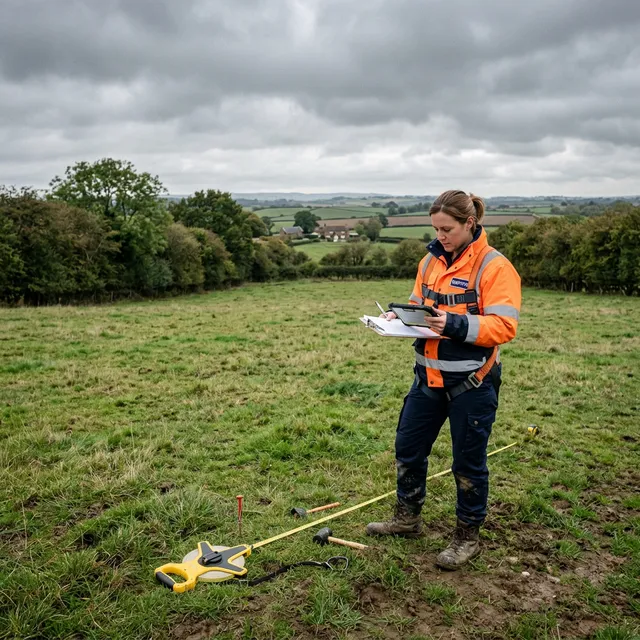
A desktop site appraisal is not a substitute for site visit specialist work. The following needs separate commission once the appraisal flags them:
Phase 2 intrusive ground investigation (boreholes, trial pits) where Phase 1 desk study identifies potential contamination.
Protected species surveys (bat emergence, great crested newt eDNA, breeding bird surveys) where ecology screening identifies habitat features. These are seasonally constrained and typically take 4 to 8 weeks once the survey window opens.
Hydraulic flood modelling where the site is in Flood Zone 3 with complex flood mechanisms.
Heritage Impact Assessment with full setting analysis where the site is within 200m of multiple listed buildings or in a conservation area.
Topographical survey, tree survey to BS 5837, and noise monitoring all require site attendance and are scoped as separate instructions.
A good site appraisal report will name each specialist study that the constraint screening triggers, with indicative cost and timeline. That is the single most useful output a buyer can receive.
Cost: traditional consultant vs desktop intelligence
Traditional chartered planning consultancy in 2026 charges between £1,500 and £5,000 for a written site appraisal report. The variance depends on site complexity and the consultant's seniority. London-based practices typically sit at the upper end. Turnaround is 2 to 4 weeks, longer if the consultant orders third-party data packs (Landmark, GroundSure) which take their own 2 to 5 working days.
Desktop intelligence covers the same constraint scope from £295 to £995 in 48 hours. The methodology difference is real: integrated data sources rather than third-party-pack procurement, automated cross-domain analysis rather than manual cross-reference, structured templating rather than bespoke writing. The data sources are the same. The difference is how they are combined and presented.
For Site Intelligence specifically: Site Appraisal (1 to 9 dwellings) £295; Site Appraisal (10 to 50 dwellings) £395; Site Appraisal (51 to 200 dwellings) £595; Feasibility Intelligence (multi-domain, includes constraint-triggered desktop reports) from £995. Pricing is on the For Developers page.
On a single straightforward site, the cost gap is £1,000 to £4,000. On a 5-site portfolio screening exercise, the gap is £5,000 to £20,000. The methodology is honest about its limits (see "what it does NOT cover" above), but for the scope it claims, the price difference is real.
Four scenarios where a site appraisal pays for itself in the first month
A site appraisal is not always worth the £295 to £5,000 you might spend on it. These are the four scenarios where it consistently is.
1. You are about to exchange on land. The cost of a £295 to £995 desktop appraisal is dwarfed by the cost of a 5% deposit on a £1m site if the planning route turns out to be impossible. We have seen developers take options on sites in Flood Zone 3b, in active conservation areas, and on Green Belt land that does not satisfy the grey belt tests. A pre-exchange site appraisal would have flagged each one. Ratio: appraisal cost is typically 0.05 to 0.5% of the deposit at risk.
2. You are deciding whether to commission an architect. Architect feasibility studies cost £2,000 to £10,000 and take 4 to 8 weeks. A desktop site appraisal beforehand answers the question the architect cannot answer (does planning policy allow it) before you commit fees. We see this most often on green belt sites, listed building extensions, and HMO conversions where the architectural feasibility is straightforward but the planning policy is the bottleneck.
3. You are reviewing 5 to 20 sites in a strategic portfolio. Doing 20 traditional consultant appraisals costs £30,000 to £100,000 and takes 6 months. Doing 20 desktop appraisals costs £4,000 to £6,000 and takes a fortnight. The output is the same shape (a constraint-screened verdict per site) and the relative ranking that matters for portfolio decisions is preserved across both methodologies. This is the strongest case for desktop, hands down.
4. You are responding to a deadline. If you have 4 weeks until pre-app, the architect needs informed direction now. A desktop site appraisal in 48 hours unblocks the design brief. Traditional appraisal (2 to 4 weeks) eats your entire pre-app preparation window. The methodology arguments are secondary to the programme reality.
How to commission a site appraisal in 2026
A few questions to ask before accepting a quote.
What does the appraisal include vs exclude. Insist on a contents list that names each constraint domain. Avoid open-ended scope.
What NPPF version does the appraisal reference. December 2024 numbering is the correct answer for any application post-December 2024.
Which 5-year supply / Housing Delivery Test reading are you using. Both are public; the answer should be specific and dated.
Will the appraisal name the specialist studies that need to follow. A good appraisal flags ecology, heritage, ground investigation, and transport scoping. A weak one stays vague.
What is the turnaround. Anything more than 4 weeks for a desktop appraisal in 2026 is outside the market norm.
Who reviews the output before delivery. RICS-regulated firms have due diligence obligations under the RICS AI Standard (March 2026); see our due-diligence pack for how an AI-led appraisal maps to those obligations.
When you do NOT need a site appraisal
A few cases where the cost is not justified.
Householder extensions on existing residential properties without designated constraints (no listed building, not in a conservation area, not within 100m of a listed building, Flood Zone 1, no surface water flood risk shown). Permitted development rights and existing-use rights cover most of these without an appraisal.
Sites where you already hold a recent Heritage Impact Assessment, Flood Risk Assessment, and Planning Statement from a prior application. The new appraisal would mostly duplicate work already done.
Sites where the planning constraint is a single binary issue (e.g. listed building consent for internal works) that a Heritage specialist resolves directly. The appraisal does not add value above the specialist instruction.
In every other scenario (pre-acquisition, pre-architect, portfolio review, deadline-driven) a desktop appraisal at £295 to £995 is the most cost-effective insurance available in the development cycle.
Site Appraisal Report from Site Intelligence
Our Site Appraisal covers all 12 constraint domains above with a 48-hour turnaround. Pricing tiers by site size: from £295 for 1 to 9 dwellings, £395 for 10 to 50, £595 for 51 to 200. For multi-domain feasibility output (includes constraint-triggered desktop reports for the constraints actually triggered), Feasibility Intelligence is from £995 in 48 hours.
Order via the For Developers page or read the underlying methodology at what is included. For the broader picture of every report a planning application might need, see our mega-pillar guide on planning reports. For cost benchmarking against traditional consultancy, see planning report cost UK 2026.
Related Report
Site Appraisal
Planning-ready intelligence from From £295 — delivered within 48hrs
Ready to get started?
Complete desktop planning intelligence for any site in England. From £295.