Planning & Regulation August 29, 2026 6 min read
A Housing Delivery Test Result Below 75%: What It Actually Does Under the August 2026 Framework
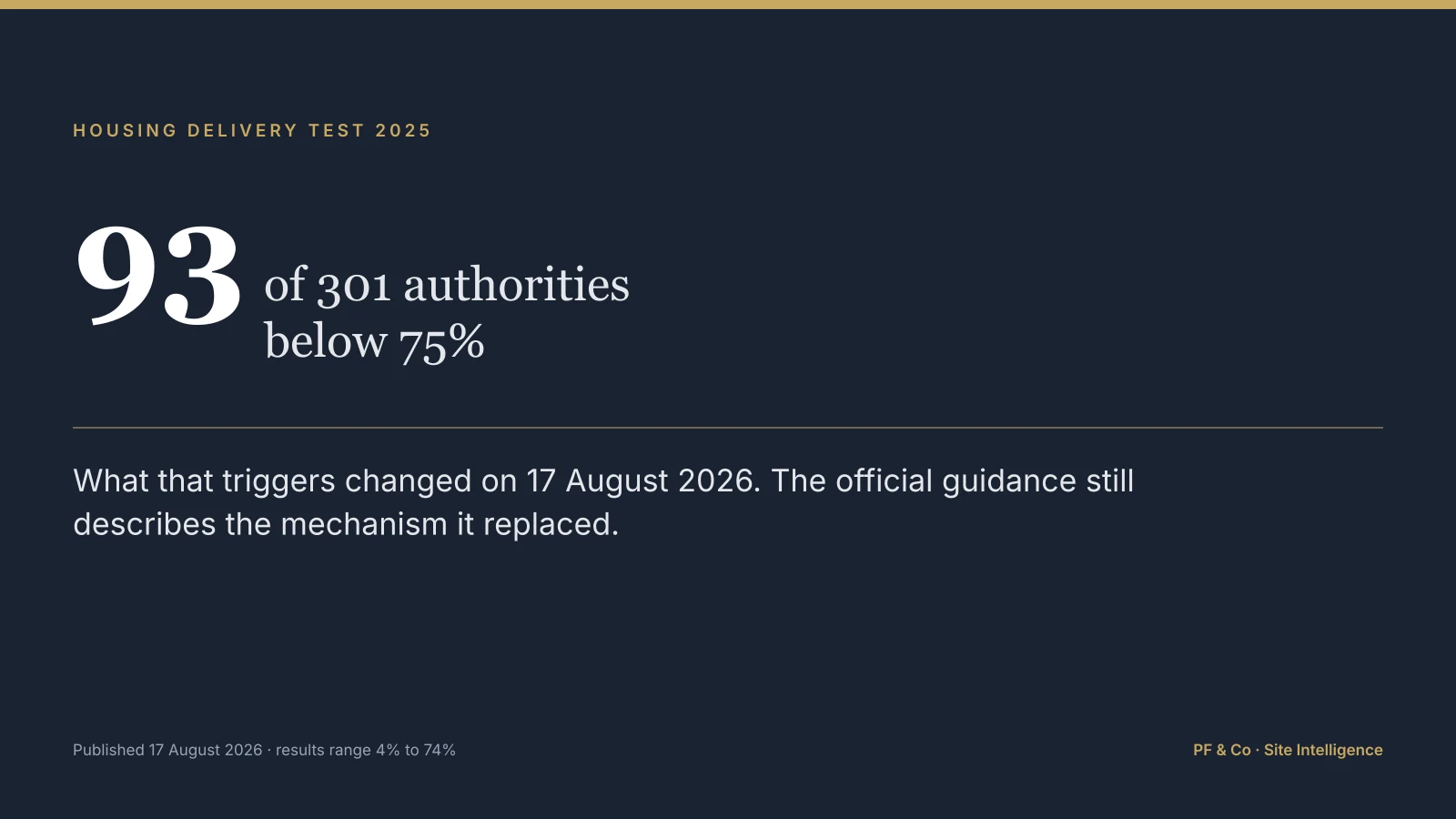
93 of 301 English councils scored under 75% in the 2025 Housing Delivery Test. What that triggers changed on 17 August 2026, and the guidance has not caught up.
On 17 August 2026 the government published the 2025 Housing Delivery Test alongside a republished National Planning Policy Framework. 93 of the 301 measured English planning authorities delivered less than 75% of their three-year housing requirement. Their results run from 4% to 74%, and not one of them sits at or above the threshold.
The number is easy to find. What it now does is not, because the Framework published that same day changed the mechanism, and the Planning Practice Guidance that explains the consequence has not been updated since December 2024.
This piece sets out what a sub-75% result triggers today, what it no longer triggers, and where the official guidance will mislead you if you read it on its own.
What a sub-75% result used to do
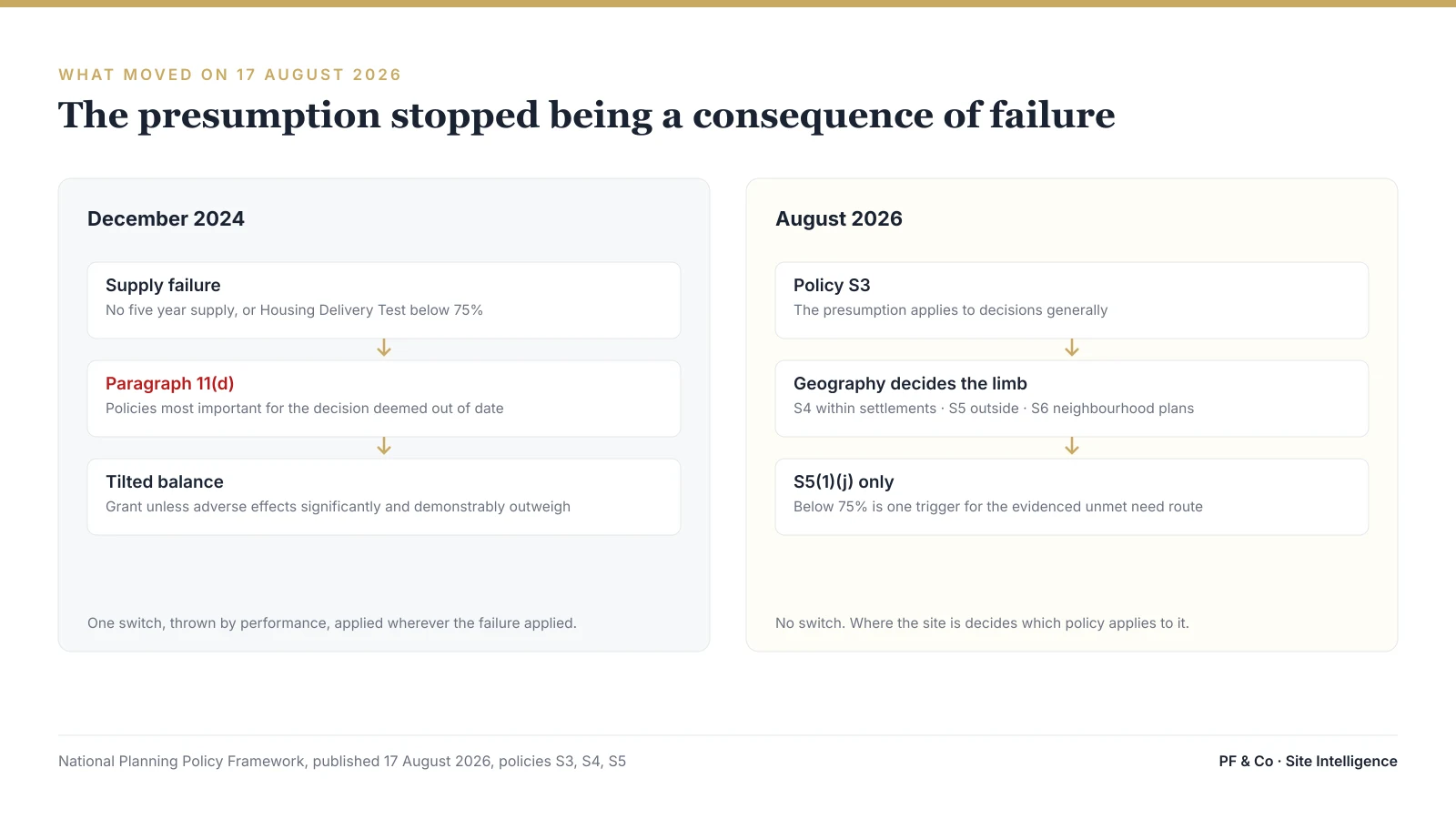
Under the December 2024 Framework the consequence was the tilted balance at paragraph 11(d). Where an authority could not demonstrate a five year housing land supply, or its Housing Delivery Test result fell below 75%, the policies most important for determining the application were deemed out of date, and permission was to be granted unless the adverse effects significantly and demonstrably outweighed the benefits.
That was a decision-level presumption switched on by a supply failure. It applied wherever the failure applied, and its force came from reversing the ordinary balance.
What changed on 17 August 2026
The republished Framework abandoned continuous paragraph numbering across its thematic chapters in favour of policy codes: 19 families, 131 policies. Paragraph 11(d) does not exist in it.
More importantly, the presumption itself moved. Policy S3 now states that decisions on development proposals should apply a presumption in favour of sustainable development, and defines what that means by geography rather than by supply performance: policy S4 applies within settlements, policy S5 outside them, and policy S6 deals with neighbourhood plans.
So the presumption is no longer something a council switches on by failing a test. It applies to decisions generally, and which limb you are in depends on where the site is.
Where the Housing Delivery Test appears now
The 75% threshold did not disappear. It moved, and it narrowed.
A result below 75% is one of the triggers for the evidenced unmet need route within policy S5, which governs development outside settlements. That route can support housing where the local planning authority cannot demonstrate a five year supply of deliverable housing sites or scores below 75% in the most recent Housing Delivery Test, and where the development would be physically well related to an existing settlement and of a scale that can be accommodated given existing or proposed infrastructure.
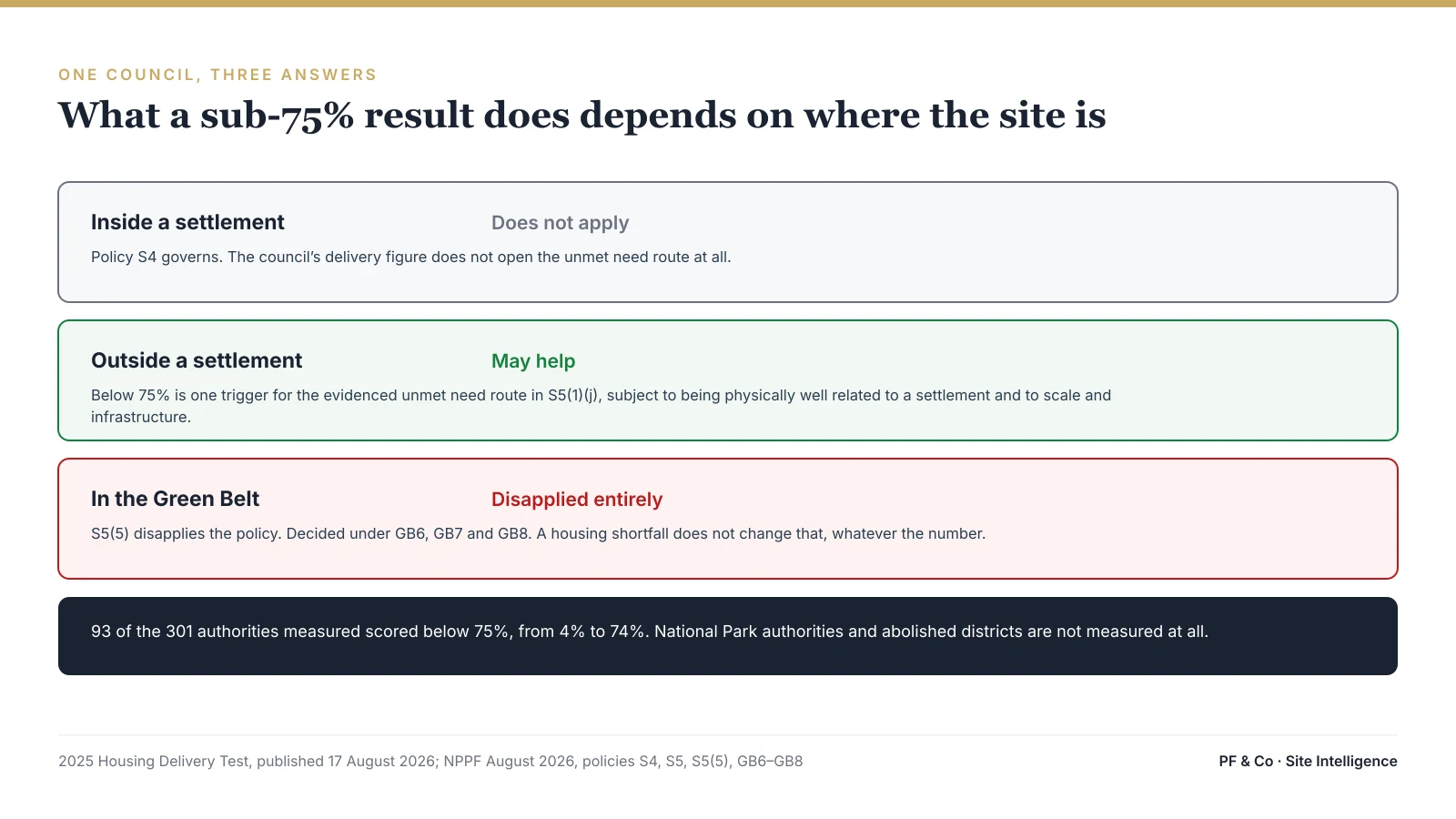
The difference matters in practice. The old mechanism reversed the balance across the board. The new one opens a specific route, outside settlements, subject to that policy's own tests. A site inside a settlement is decided under S4 whatever the council's delivery figure says.
The Green Belt exception, which is absolute
Policy S5(5) disapplies S5 to the Green Belt entirely. Green Belt proposals are decided under policies GB6, GB7 and GB8, and a housing shortfall does not change that.
This is the single most common misreading we see. A council can be at 40% on the Housing Delivery Test and it will not move a Green Belt site one inch. Very special circumstances survive, and the delivery figure is not one of them.
The guidance still describes the old mechanism
Here is the part worth knowing before you rely on a government web page.
The Framework, the Housing Delivery Test collection and the Housing Delivery Test measurement rule book were all updated on 17 August 2026. The Planning Practice Guidance on housing supply and delivery was last updated on 12 December 2024.
That guidance still lists the consequences as an action plan below 95%, a 20% buffer below 85%, and application of the presumption in favour of sustainable development below 75%. And PPG 68-008 (Reference ID 68-008-20190722) still says the presumption applies "as set out in paragraph 11d of the National Planning Policy Framework", hyperlinking to the Framework page which now serves an edition containing no paragraph 11d.
The guidance mentions August 2026 nowhere. It mentions policy S5 nowhere.
None of this makes the guidance dishonest. Practice guidance lags a Framework revision routinely, and it will be updated. But it means anyone working out the effect of a sub-75% result from the official explanation is being pointed at a mechanism that no longer exists in that form, and will apply a test that has been replaced.
What this means when you are looking at a site
Three practical consequences.
Check where the site sits before you value the council's delivery figure. Inside a settlement, S4 governs and the Housing Delivery Test result does not open the unmet-need route at all. Outside one, it may. In the Green Belt, it does not, whatever the number.
Treat the figure as a point in your favour, not a decision. The unmet-need route carries its own tests on physical relationship to a settlement, scale, and infrastructure. A council at 50% has not conceded anything.
Cite the policy, not the paragraph. A December 2024 paragraph number in a document written after 17 August 2026 is a citation into a superseded edition. It is correct only when you are quoting something that predates the republication, which is a narrow and legitimate use, and it should be obvious from the context that this is what you are doing.
The numbers, and what they do not tell you
93 authorities below 75% is roughly one in three of those measured. It is also a smaller population than people assume: National Park authorities and abolished districts are not measured at all, so a site in a National Park has no Housing Delivery Test position to cite, and its absence is not a good result.
The consequences apply concurrently. An authority below 75% is also below 85% and below 95%, so it carries the buffer and the action plan as well.
And the measurement is historic by construction. It counts net homes delivered against the requirement over the previous three years. It tells you what happened, not what the council will do with your application.
Getting this right for a specific site
The policy position is national. Which side of the threshold a council sits on, whether your site is inside or outside a settlement, and whether the Green Belt disapplies the route entirely are all site-specific, and all checkable before you spend anything.
Our free planning check reports the authority for any site in England, its Housing Delivery Test position dated to the measurement it came from, and what that consequence means under the current Framework rather than the superseded one. Where the site is in the Green Belt it says so, and says that S5(5) disapplies the route. It is a screening steer from published data, not planning advice.
Ready to get started?
Complete desktop planning intelligence for any site in England. From £295.