Short answer
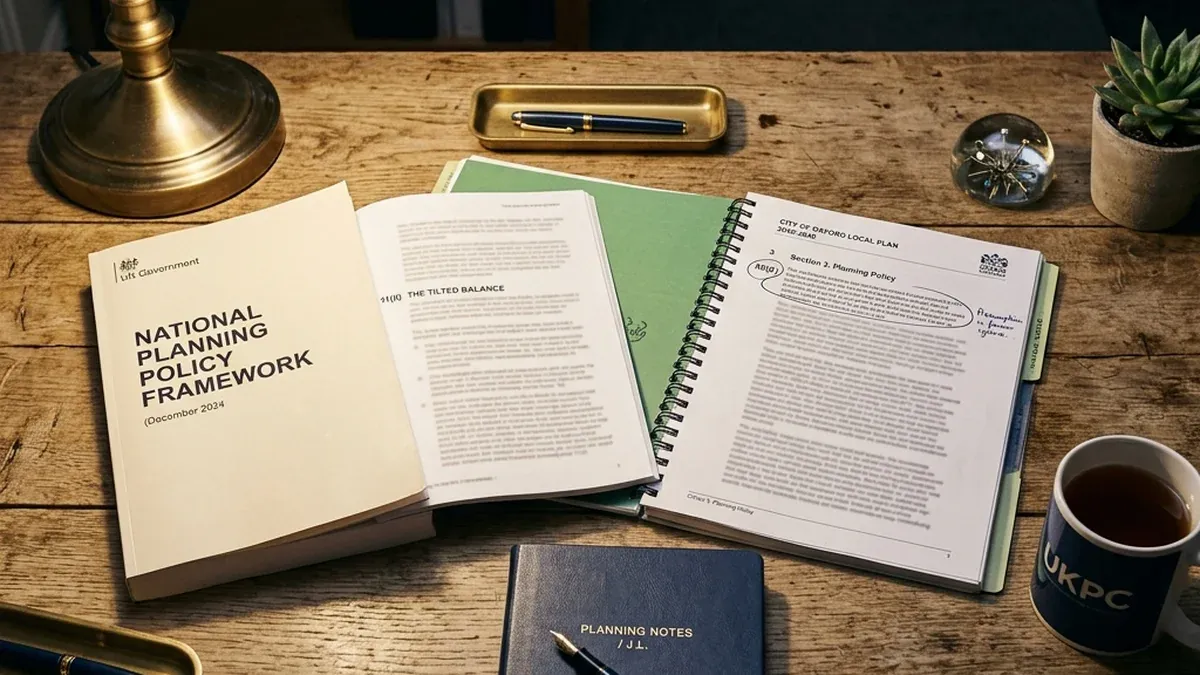
You are bidding on a small site, 6 to 10 units on the edge of a settlement, and the vendor wants an answer in two weeks. A planning statement is the document that frames how your scheme complies with the development plan and the National Planning Policy Framework, and sets out the material considerations the case officer should weigh. For a small developer, it is the difference between a validated application and a refusal that burns your architect fees and option costs.
PF & Co drafts the planning statement inside the Pre-Application Pack (from £2,250) and the Consultant Handover Pack (tailored). Site Appraisal (from £295) tells you whether commissioning one is worth the spend.
When a planning statement is needed
A planning statement is rarely strictly mandatory below the major-application threshold, but the cases where it earns its place are wider than the LPA's local validation list suggests. This page covers England. Scotland, Wales and Northern Ireland operate separate planning systems and are not within scope.
- LPA local validation lists. Many English LPAs require a planning statement on their local list for anything above householder. Submitting without one risks a validation delay of two to six weeks.
- Pre-application stage. A draft planning statement gives the officer something to react to, rather than a blank-sheet conversation.
- Major applications. 10 or more dwellings or 1,000 sqm or more of floorspace. A statement is expected on the file.
- Tilted balance sites. Where the LPA cannot demonstrate a five-year housing land supply, or has failed the Housing Delivery Test, the NPPF policy S5(1)(j) unmet-need route may be available for a site outside a settlement. The statement pleads the point. It is a decision-maker judgement, not automatic.
- Local Plan policy conflict. Where the scheme cannot rely on strict compliance, material considerations have to be argued explicitly.
- Green Belt and grey belt. Very Special Circumstances, or the grey belt tests at NPPF policies GB6 and GB7 with the golden rules at policy GB8, need to be evidenced on the face of the application. See our grey belt site check guide.
- Heritage harm. The public benefits balancing test under NPPF policy HE6, with setting and significance under policy HE5(1).
- Acquisition stage. On subject-to-planning purchases or option agreements, a desktop policy read sized for bid risk avoids overpaying for a site the policy framework will not support.
What a planning statement contains
A planning statement for a small-developer scheme typically follows this structure:
- Site and context. Location, existing use, planning history, designations.
- The proposal. Dwelling count, mix, scale, access, red-line.
- Policy compliance. Policy-by-policy assessment against the adopted Local Plan and any made neighbourhood plan.
- Material considerations. Adopted SPDs, recent appeal decisions, emerging policy, five-year housing land supply position, Housing Delivery Test result.
- Planning balance. The policy S5(1)(j) unmet-need argument where it is open, or the ordinary S4 or S5 balance where it is not. Public benefits where heritage harm is in play.
- Conclusion. Recommended planning route and the case for approval.
| In our planning statement | Sourced from |
|---|---|
| Site description and existing use | OS basemap, aerial imagery, Land Registry |
| Planning history | LPA planning portal, Historic England NHLE |
| Policy framework | NPPF (August 2026, the S3 to S5 route), Local Plan, adopted SPDs |
| Five-year housing land supply position | LPA published 5YHLS statement |
| Housing Delivery Test result | DLUHC published HDT data |
| Compliance with the Development Plan | Policy-by-policy assessment |
| Material considerations | Adopted SPDs, recent appeal decisions, neighbourhood plans, emerging policy |
| Public benefits where heritage harm engages NPPF policy HE6 | Combined heritage and planning judgement |
| Recommended planning conclusion | Combined judgement with Inspector-style framing |
The desktop structure is set out in what is included in our desktop pack, drawing on the GOV.UK National Planning Policy Framework as the primary reference.
What the desktop planning statement does not replace
The desktop planning statement does the policy and material-considerations analysis. It is not contested advocacy.
Not included: MRTPI formal planning representation under professional indemnity for contested applications, called-in applications, or appeals. Chartered planner attendance at committee or Public Inquiry. Statement of Case for appeals. Proof of evidence. Rebuttal evidence. Legal opinion on policy interpretation. Specialist 5YHLS or HDT methodology challenges where the LPA's published position is contested on its underlying assumptions.
Where any of these are triggered, the report names the specialist commission, indicative cost range and typical timeline so the developer can budget the next step.
Four packs sized to four decisions
Site Appraisal checks whether a planning statement is worth commissioning. The Pre-Application Pack drafts it. The Consultant Handover Pack delivers wording drafted to submission standard for consultant review.
| Pack | What it does for the planning case | Decision moment | Price |
|---|---|---|---|
| Site Appraisal | Identifies development plan position, 5YHLS / HDT, tilted balance trigger, indicative planning route. Tells you whether a planning statement is worth commissioning | Bid or pre-screening | From £295 |
| Feasibility Intelligence | Adds planning case strength assessment to the bid model and lender pack | Pre-acquisition or pre-architect | From £995 |
| Pre-Application Pack | Drafts the full planning statement ready for the pre-application response | Pre-app meeting booked | From £2,250 |
| Consultant Handover Pack | Tailored planning statement drafted to submission standard for consultant review | Application submission | Tailored |
Heritage, Green Belt and tilted balance sites need longer for the full statement. We confirm the delivery date with the scope and the price, before you pay.
For the wider report context, see our mega-pillar guide on what reports you need for planning permission.
Send the boundary today
Send postcode, red-line boundary, intended use, indicative dwelling count and any pre-app correspondence. You receive the desktop planning case position with 5YHLS and HDT read, tilted balance applicability, validation risk against the LPA local list, and the recommended planning route. After delivery, a 30-minute call walks you through the policy reasoning and the next commission if the site warrants it.
£295 to walk away from a policy-non-compliant scheme before you spend on architects. £995 for the planning case strength inside the bid model. £2,250 to walk into pre-app with the draft planning statement on the table.
Request a Site Appraisal quote or see a sample report. For wider context, see GOV.UK planning permission guidance and the RTPI on the role of chartered planners.