Planning & Regulation 13 November 2026 12 min read
CIL in 2026: Why the Levy You Pay Is Not the Rate Printed in the Charging Schedule
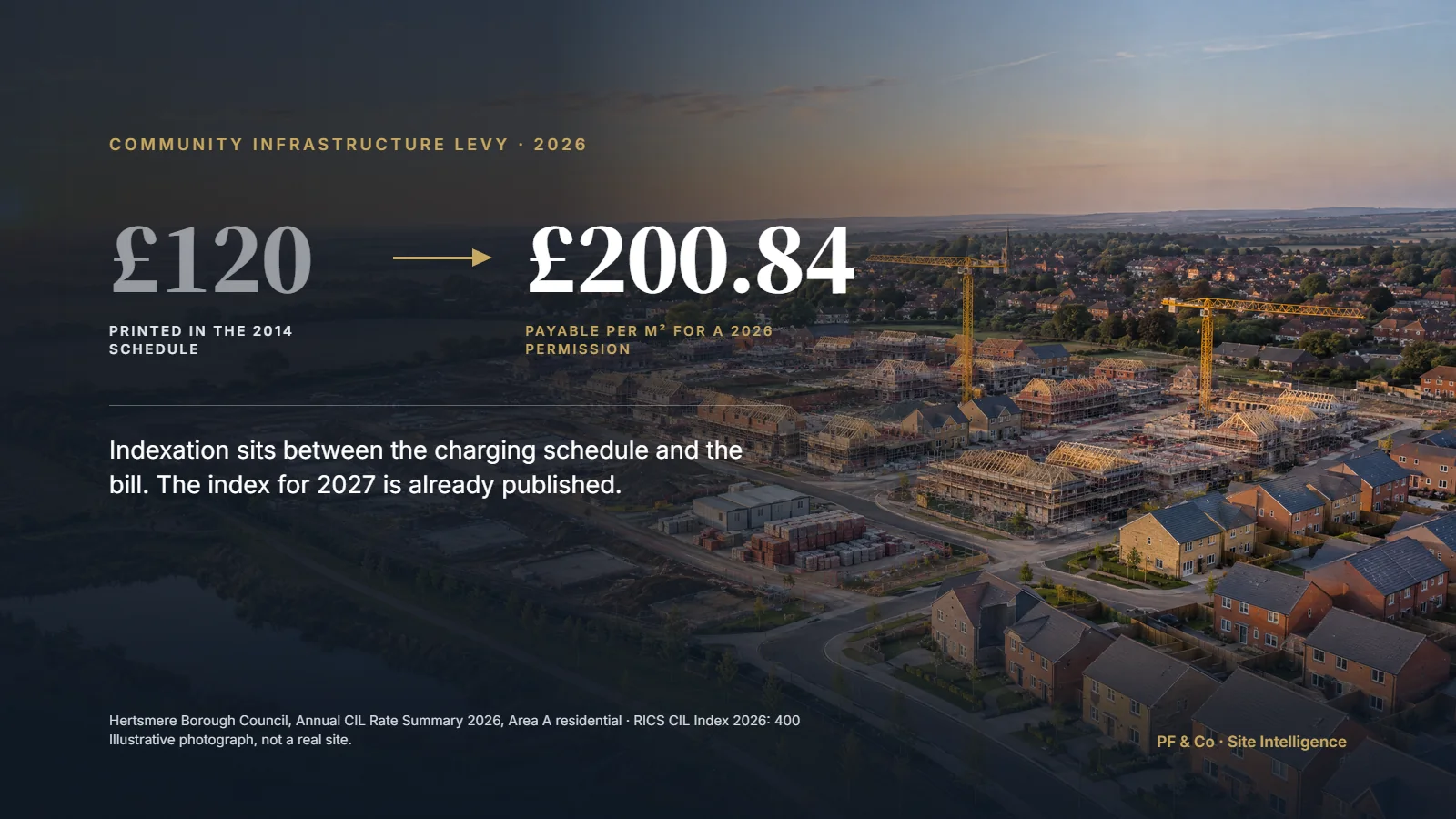
Hertsmere's printed £120 per m² Area A residential rate is £200.84 for a 2026 permission. How indexation works, why the base year matters, and the 2027 figure.
A community infrastructure levy charging schedule prints a rate per square metre. Unless the schedule took effect this year, that rate is not what the levy will cost. In Hertsmere, new homes in the borough's Area A are charged at £120 per square metre in a schedule that took effect on 1 December 2014. For a planning permission granted in 2026, the council's own published rate is £200.84 per square metre.
The difference is indexation. It is set by statute, it usually rises, and the figure for next year was published on 26 October 2026: 412, up from 400. An appraisal that carries the printed rate understates the levy. One that carries this year's indexed rate for a permission expected next year understates it again.
This piece sets out the formula as it applies in England, where each number in it comes from, why the year a charging schedule took effect matters as much as the rate, and how to check the figure for a site before you price it.
The short version.
- The levy is the printed rate times the chargeable area, multiplied by the index for the year permission is granted and divided by the index for the year the charging schedule took effect.
- The second index never changes for a given schedule, so the older the schedule, the further the bill usually drifts from the printed rate.
- Permissions granted in 2026 take an index of 400. From 1 January 2027 the figure is 412, which is 3.0% higher.
- The base figure should come from the charging authority's own annual rate summary, not from a national table.
The formula in the Regulations
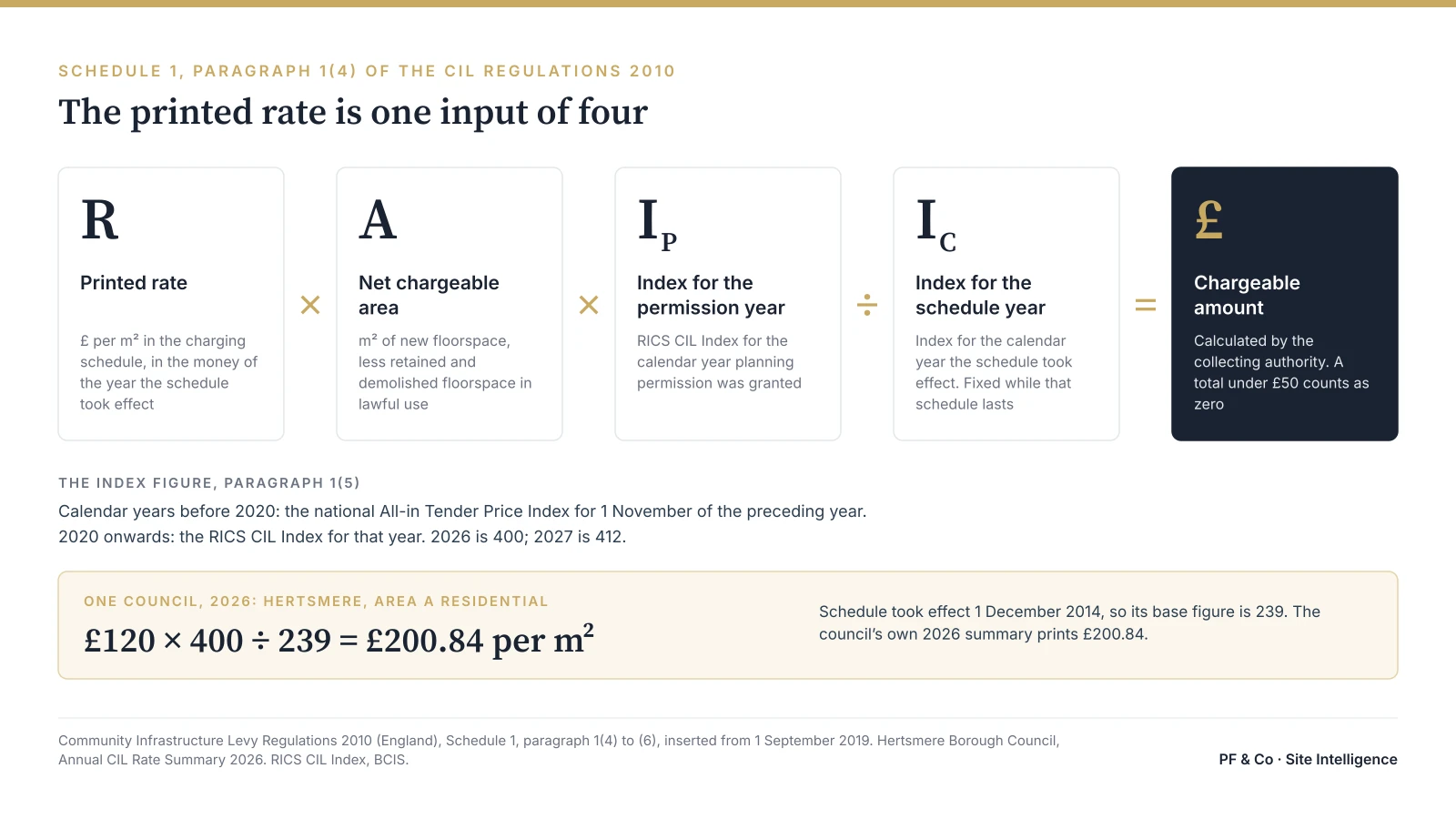
For England, the calculation is in Schedule 1 to the Community Infrastructure Levy Regulations 2010, inserted from 1 September 2019 by the Community Infrastructure Levy (Amendment) (England) (No. 2) Regulations 2019. Regulation 40 now directs the collecting authority to calculate the chargeable amount in accordance with that Schedule. For each rate that applies, paragraph 1(4) sets the amount as R × A × IP ÷ IC, where:
- R is the rate taken from the charging schedule.
- A is the deemed net area chargeable at that rate: broadly the new floorspace, less certain retained floorspace and less floorspace in lawful use that is demolished, under the formula in paragraph 1(6).
- IP is the index figure for the calendar year in which planning permission was granted.
- IC is the index figure for the calendar year in which the charging schedule containing rate R took effect.
The collecting authority does the calculation, and a total under £50 is deemed to be zero (paragraph 1(2)). Paragraph 1(5) then defines the index figure. For any calendar year before 2020 it is the national All-in Tender Price Index figure for 1 November of the preceding year. For 2020 and every year since, it is the RICS CIL Index "published in November of the preceding calendar year", with fallbacks to the All-in Tender Price Index and then the retail prices index if the RICS figure is not published.
Where the index comes from
The RICS CIL Index is prepared by the Building Cost Information Service for the Royal Institution of Chartered Surveyors. BCIS bases it on its All-in Tender Price Index, which tracks what contractors charge for building work, and calculates each year's figure as the average of four quarters of that index, ending with the third quarter of the year of publication. BCIS publishes it on the same base as the old tender price index, which is why a schedule that took effect before 2020 can be indexed by it.
| Permission granted in | RICS CIL Index | Published |
|---|---|---|
| 2020 | 334 | 28 October 2019 |
| 2021 | 333 | 26 October 2020 |
| 2022 | 332 | 25 October 2021 |
| 2023 | 355 | 24 October 2022 |
| 2024 | 381 | 23 October 2023 |
| 2025 | 391 | 28 October 2024 |
| 2026 | 400 | 27 October 2025 |
| 2027 | 412 | 26 October 2026 |
Three things follow from that table.
The figure for 2027 is already public. Permissions granted from 1 January 2027 will be indexed at 412. Charging authorities must publish their 2027 summaries between 2 and 31 December 2026 under regulation 121C(1), but the index they will use is out now, and an appraisal can apply it today.
Can indexation reduce the levy? Yes. The index for 2021 was 333 and for 2022 was 332, both below the 334 for 2020, and the formula has no floor. Arun District Council, whose schedule took effect on 1 April 2020, publishes the effect: its £70 rate was £69.79 in 2021 and £69.58 in 2022, before rising every year since to £83.83 for 2026.
The figure is out by the end of October. BCIS publishes it on the fourth Monday of October, and government guidance says it will be published on or around 1 November and apply from 1 January of the following year (PPG 25-104). The 2026 and 2027 figures appeared on 27 October 2025 and 26 October 2026, and every 2026 summary quoted in this piece uses the October 2025 figure of 400. Anyone pricing a permission expected in January has the number before November.
Why the year the schedule took effect matters
IC is fixed when a charging schedule takes effect and does not move for as long as that schedule is in force. IP moves every January. The multiplier between the printed rate and the payable rate is the ratio of the two, so as a rule the older the schedule, the larger the gap.
Hold a printed rate constant at £100 and run it through six real charging schedules and one taking effect this year, using each authority's own published base figure and this year's index of 400. The payable rate runs from £100.00, for any schedule taking effect this year, to £167.36 for one that took effect in December 2014.
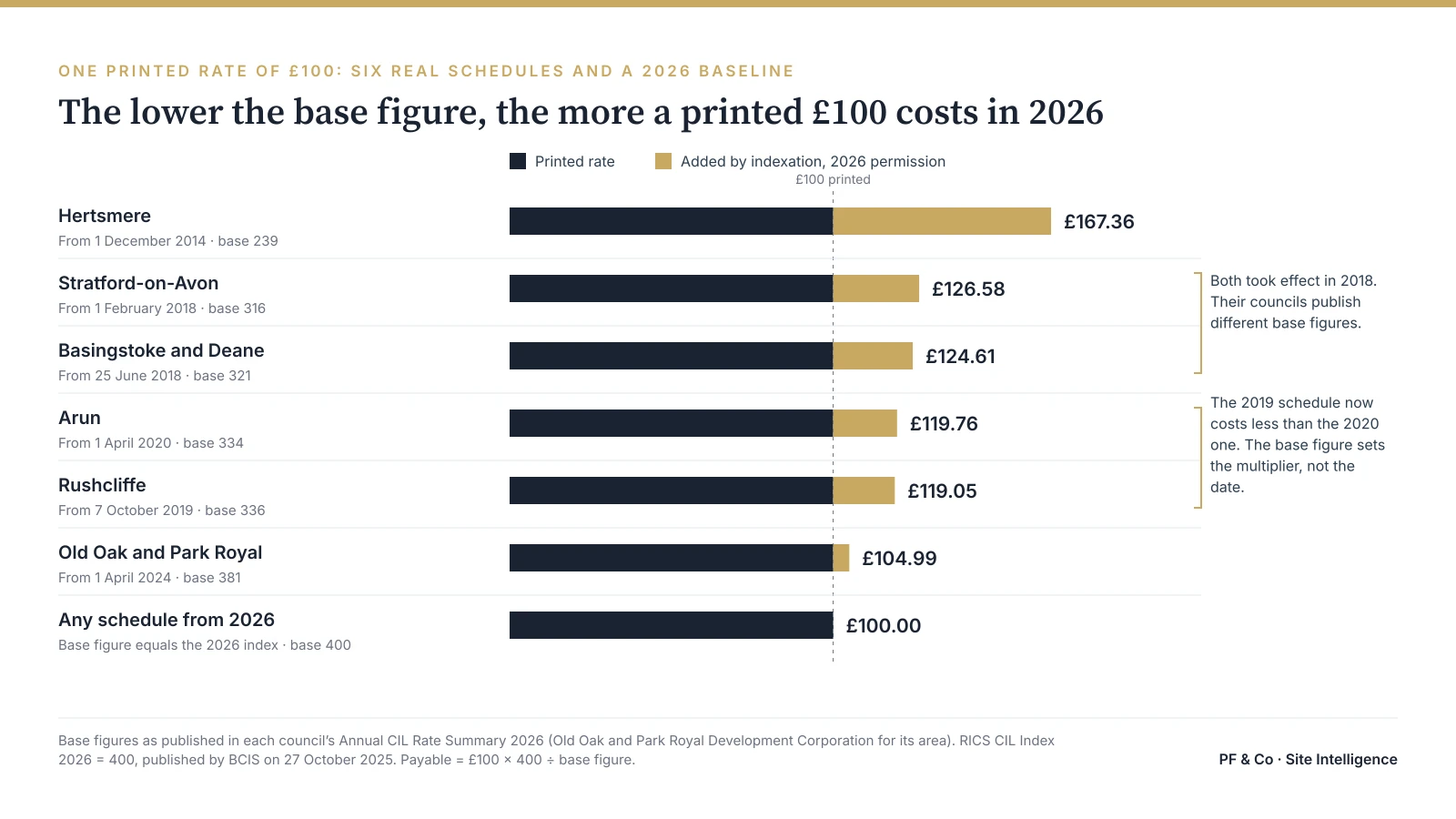
Two details in that chart are worth knowing before you rely on anyone's table.
Two schedules from the same year can carry different base figures. Stratford-on-Avon's schedule took effect on 1 February 2018 and its 2026 summary uses 316, which it describes as the index figure for the first quarter of 2018. Basingstoke and Deane's took effect on 25 June 2018 and its summary uses 321. The Regulations name one figure for each calendar year before 2020, the national All-in Tender Price Index for 1 November of the preceding year, yet these two councils publish different numbers for 2018. The collecting authority calculates the charge, and its own summary is the best evidence of the figure it will use. Take it from there, and if it does not match what you expected, raise it with the authority before you rely on it.
The base figure sets the multiplier, not the date. Rushcliffe's schedule took effect in October 2019 with a base of 336, and Arun's in April 2020 with a base of 334. A £100 rate in the older schedule now costs £119.05, slightly less than the £119.76 it costs in the newer one.
A new schedule resets the clock
When an authority replaces its charging schedule, the new rates are in the money of the year the new schedule takes effect, and IC resets to that year's index. That changes how old and new rates compare. Hertsmere's 2014 rate of £120 for Area A is £200.84 for a 2026 permission. A hypothetical replacement schedule taking effect in 2026 at £180 would print a higher number and charge less. Compare a proposed rate with the current indexed rate, never with the old printed one.
There is one carry-over to watch. Where an outline permission was granted while the old schedule was in force and the last reserved matters are approved after a new one takes effect, Schedule 1 paragraph 2 keeps the old schedule, and its base figure, for that development (PPG 25-106).
A worked example: Hertsmere, 2026
Hertsmere Borough Council's Annual CIL Rate Summary 2026 sets out every number the formula needs. Its schedule took effect on 1 December 2014, the base figure for that year is 239, and the index for permissions granted in 2026 is 400.
| Residential charging zone | Printed rate (2014) | Indexed rate, 2026 (council) | Indexed rate, 2027 (our arithmetic) |
|---|---|---|---|
| Area A (Elstree, Borehamwood and Potters Bar) | £120 per m² | £200.84 per m² | £206.86 per m² |
| Area B (Bushey and Radlett) | £180 per m² | £301.26 per m² | £310.29 per m² |
The 2026 column is the council's. The 2027 column applies the published 2027 index of 412 to the same base figure; the council's own 2027 summary is due by 31 December 2026.
Now a scheme. Suppose it adds 400 square metres of new homes in Area A, with no existing floorspace to deduct and no relief or exemption claimed. Read off the printed rate, the levy looks like £120 × 400 = £48,000. The formula gives £120 × 400 × 400 ÷ 239 = £80,334.73. Working from the council's rate, rounded to the penny, gives £80,336.00; the difference is rounding. The printed reading is about 60% of the real figure, and a gap of £32,334.73 is the kind of number that decides a land bid.
The calendar decides which index you get
Because IP is the index for the calendar year in which permission was granted, the same scheme can carry a different bill depending on the date on the decision notice.
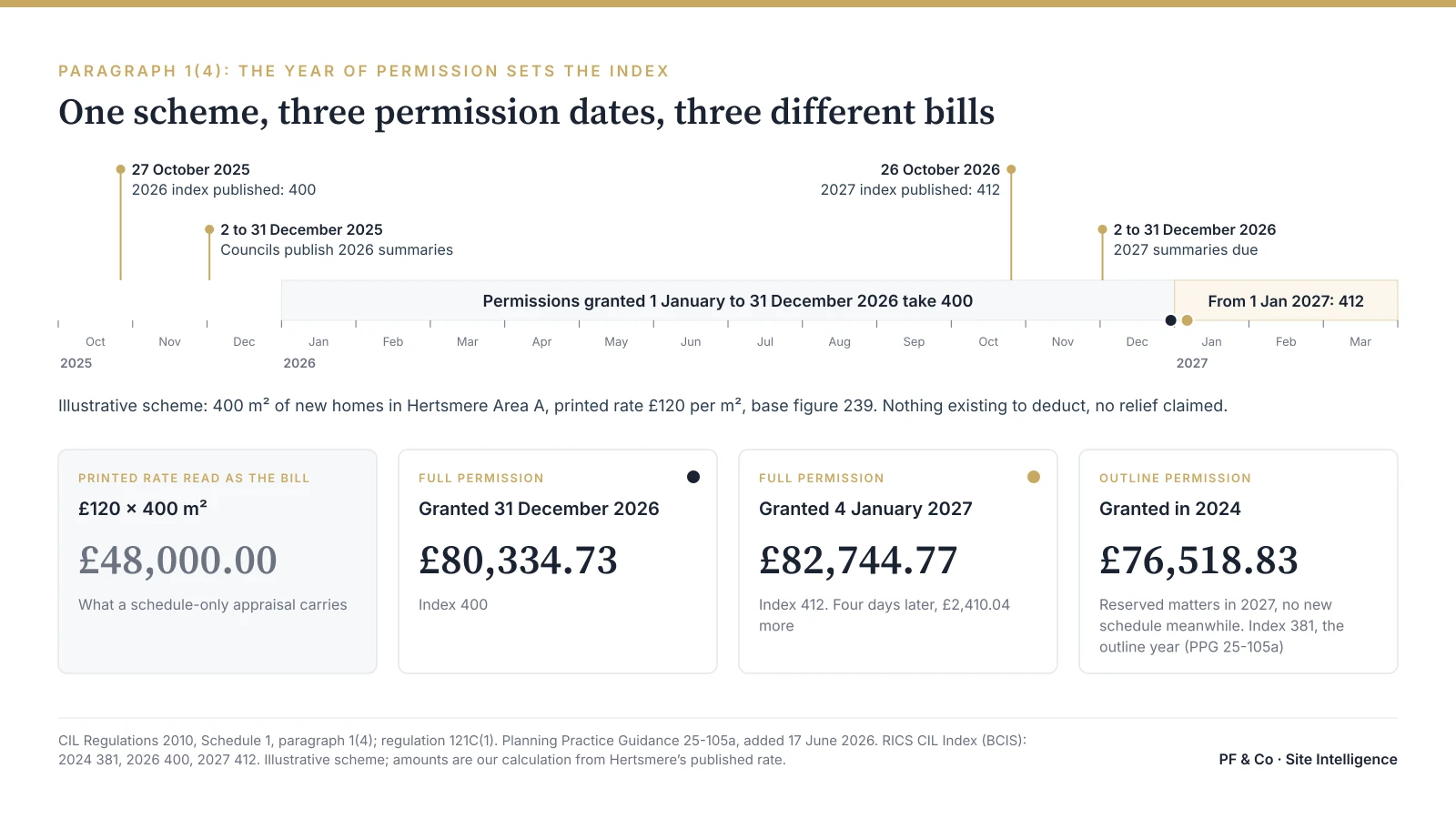
- Granted on 31 December 2026: index 400, £80,334.73.
- Granted on 4 January 2027: index 412, £82,744.77, which is £2,410.04 more for a decision issued four days later.
- Outline granted in 2024, reserved matters approved in 2027: index 381, £76,518.83, assuming no replacement schedule takes effect before then.
Which year's index applies to an outline permission? The year the outline was granted. Planning Practice Guidance added on 17 June 2026 says so directly: the IP figure for an outline permission is the year in which the outline permission was granted, "irrespective of the date at which 'last reserved matters' are approved, or whether the permission is phased" (PPG 25-105a). For an outline that is not phased, the permission first permits development when the last reserved matter is approved (regulation 8(4)), and, subject to the carry-over described above, the schedule in force then is the one that applies. The index stays at the outline year.
Section 73 permissions follow their own route. Where a variation increases the levy, the guidance charges the new elements at the latest indexed rate, while the rest keeps the rate in place when it was granted (PPG 25-105).
What this means before you commit to a site
Price the indexed rate, never the printed one. The printed rate is a base-year figure. For a schedule that took effect in 2014, as Hertsmere's did, the payable rate in 2026 is two thirds higher.
Use the index for the year you expect permission. A scheme heading for a decision in 2027 should carry 412 now. A scheme with an outline already granted keeps the outline year's figure.
Take R and IC from the charging authority's own summary. Every charging authority in England must publish an annual CIL rate summary each December for the following year, stating when each schedule took effect, each rate, both index figures, and the indexed rate (regulation 121C). The summary is a guide: the amount due is the chargeable amount stated on the liability notice the collecting authority issues once permission first permits development (regulation 65). In London the summary must also say where the Mayor charges, because the Mayor's levy is a second charge with its own schedule and its own base year.
Check whether a new schedule is coming. A replacement schedule changes both the rate and the base figure for permissions that first permit development after it takes effect. Compare any proposed rate with today's indexed rate.
Keep the formula in its place. It produces the charge before reliefs and exemptions, which have their own rules, and the deduction for existing floorspace in lawful use turns on facts about the buildings on the site.
The Framework treats the levy as one way development pays for what it needs: NPPF policy HC3(1)(b) asks proposals that would bring significant numbers of additional people to an area to provide for the new or improved community facilities and public service infrastructure necessary to make them acceptable in planning terms, "whether by direct provision or a contribution to off-site improvements (which may be through Community Infrastructure Levy payments, where applicable)". Where a levy is charged, the amount is set by formula rather than agreed. It is arithmetic, and every input except the floorspace and the date of permission is published.
Getting the figure right for a specific site
Where do I find the indexed rate for my council? On the charging authority's website, which is where regulation 121C(3) requires the annual CIL rate summary to be published. Read the date each schedule took effect and the base figure alongside the indexed rate, and check whether the authority also lists a second levy.
The judgement sits in the two inputs that are not published: the net chargeable area once existing buildings are taken into account, and the year in which permission is likely to be granted. If you would like the levy worked through for a particular site, alongside the other costs that decide a bid, get in touch.
Sources
The formula is quoted from Schedule 1 to the Community Infrastructure Levy Regulations 2010 the annual summary duty from regulation 121C and the liability notice from regulation 65, all read from the current revised text on legislation.gov.uk. Index figures are from the RICS CIL Index page published by BCIS, and for 2020 from Arun District Council's published table. Rates and base figures are from each authority's Annual CIL Rate Summary 2026. Guidance references are to the Community Infrastructure Levy section of Planning Practice Guidance, last updated on 17 June 2026. Framework references are to the National Planning Policy Framework, August 2026. Worked amounts are our own arithmetic from those published inputs, as at 12 November 2026.
This is general information about how the levy is calculated in England. It is not advice on a particular site, and a liability should always be confirmed with the collecting authority.
Ready to get started?
Complete desktop planning intelligence for any site in England. From £295.