Planning & Regulation Mar 17, 2026 4 min read
The Future Homes Standard: What Every Developer Needs to Know Before December 2026
Future Homes Standard: new homes must cut carbon 75-80% against the 2013 Part L baseline. Legislation expected December 2026, compliance by December 2027.
The Future Homes Standard is coming, and it will fundamentally change how new homes are designed, built, and heated in England. Legislation is expected to be laid by December 2026, with a transition period meaning all new homes must comply by December 2027. If you are a developer with schemes in the pipeline that will break ground in 2027 or later, the time to understand this standard is now — not when Building Control rejects your plans.
The 75-80% Carbon Reduction Target
The headline requirement is a 75-80% reduction in carbon emissions compared to the 2013 Part L baseline. To put that in context, the 2021 interim uplift to Part L required a 31% reduction. The Future Homes Standard more than doubles that target. Achieving this level of performance requires a fundamentally different approach to building fabric, heating systems, and energy generation. Incremental improvements to current designs will not be enough.
The End of Gas Boilers in New Homes
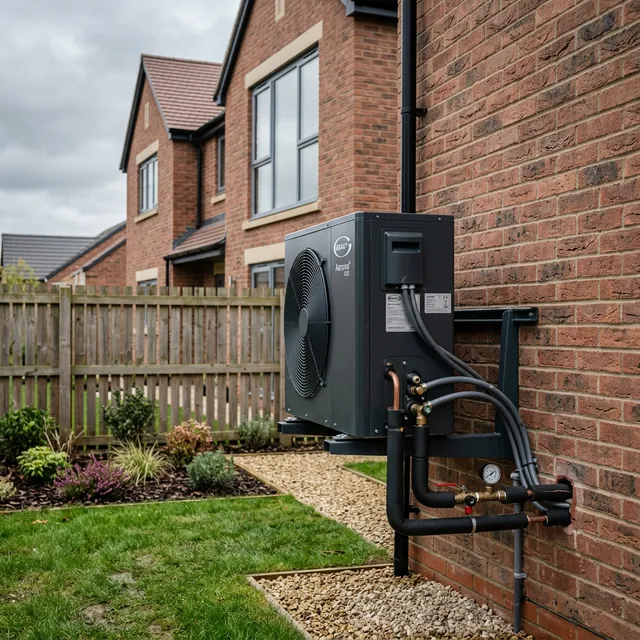
The most significant practical change is the effective ban on gas boilers in new homes. The Future Homes Standard requires low-carbon heating as the primary heat source, which in practice means air source heat pumps, ground source heat pumps, or heat networks. Gas combination boilers — which currently heat around 85% of new homes in England — will not be compliant. This is not a future aspiration; it is a regulatory requirement that will be enforced through Building Control.
For developers, the cost implications are substantial but not as severe as early estimates suggested. An air source heat pump system typically costs £8,000-£12,000 installed, compared to £2,500-£4,000 for a gas boiler. However, the running cost differential is narrowing as gas prices remain elevated and the electricity grid decarbonises. More importantly, the Future Homes Standard allows developers to factor heat pump costs into build cost assumptions from the outset, rather than treating them as an add-on.
Enhanced Fabric Standards and Solar PV Requirements
Building fabric performance is the other major change. The standard requires significantly improved thermal performance across walls, floors, roofs, and windows. Window U-values must achieve 1.2 W/m2K or lower. Wall U-values are expected to require 0.15-0.18 W/m2K, compared to the current 0.26 W/m2K requirement. This means thicker insulation, better detailing at junctions, and more rigorous airtightness testing. For timber frame and SIPs manufacturers, this is an opportunity. For traditional masonry builders, it requires a step change in specification.
Solar PV is expected to be a de facto requirement. While the standard is technology-neutral in principle, modelling consistently shows that achieving the 75-80% carbon reduction without on-site renewable generation is extremely difficult and uneconomic. Most compliant designs will include 2-4kW of rooftop solar PV per dwelling, adding £4,000-£6,000 per plot but significantly reducing the operational carbon calculation.
Transition Arrangements and the Building Regulations Deadline
The transition arrangements are critical for anyone with live schemes. The current expectation is that the standard will apply to Building Regulations applications submitted after the transition deadline — not to planning applications. This means a scheme with planning permission granted in 2026 but Building Regulations submitted in 2028 will need to comply with the Future Homes Standard. Developers who want to build to current Part L standards need to ensure their Building Regulations applications are submitted before the transition date.
Viability, Cost Impact and the Skills Gap
Viability is the elephant in the room. The additional build cost of a Future Homes Standard compliant home is estimated at £5,000-£10,000 per plot on top of current Part L 2021 costs. For a 50-unit scheme, that is £250,000-£500,000 in additional construction cost. This needs to be reflected in land values, development appraisals, and funding applications. Lenders and investors are already asking about FHS compliance in their due diligence — if your appraisal does not account for it, expect questions.
There is also a skills gap to consider. Heat pump installation requires MCS certification, and the current installer base is not large enough to service the volume of new homes expected from 2027 onwards. Developers who establish relationships with certified installers early will have a competitive advantage. Those who wait may face installation delays that push back completion timelines.
The practical step for any developer with schemes in the pipeline is straightforward: model the Future Homes Standard impact now. Understand what the additional build costs are for your specific house types, what the impact is on your development appraisal, and whether your current supply chain can deliver compliant specifications. Our Energy Statement does exactly this — it screens your scheme against Part L compliance, models renewable energy feasibility, assesses overheating risk under Part O, and flags MEES exposure for any rental units. If you are designing a scheme that will be built under the new standard, this is the report that tells you what it will cost and what you need to specify.
Related Report
Feasibility Intelligence
Planning-ready intelligence from From £995 — delivered within 48hrs
Ready to get started?
Complete desktop planning intelligence for any site in England. From £295.