Planning & Regulation 27 August 2026Updated 3 October 2026 17 min read
Re-Basing a Planning Citation Library After the August 2026 NPPF
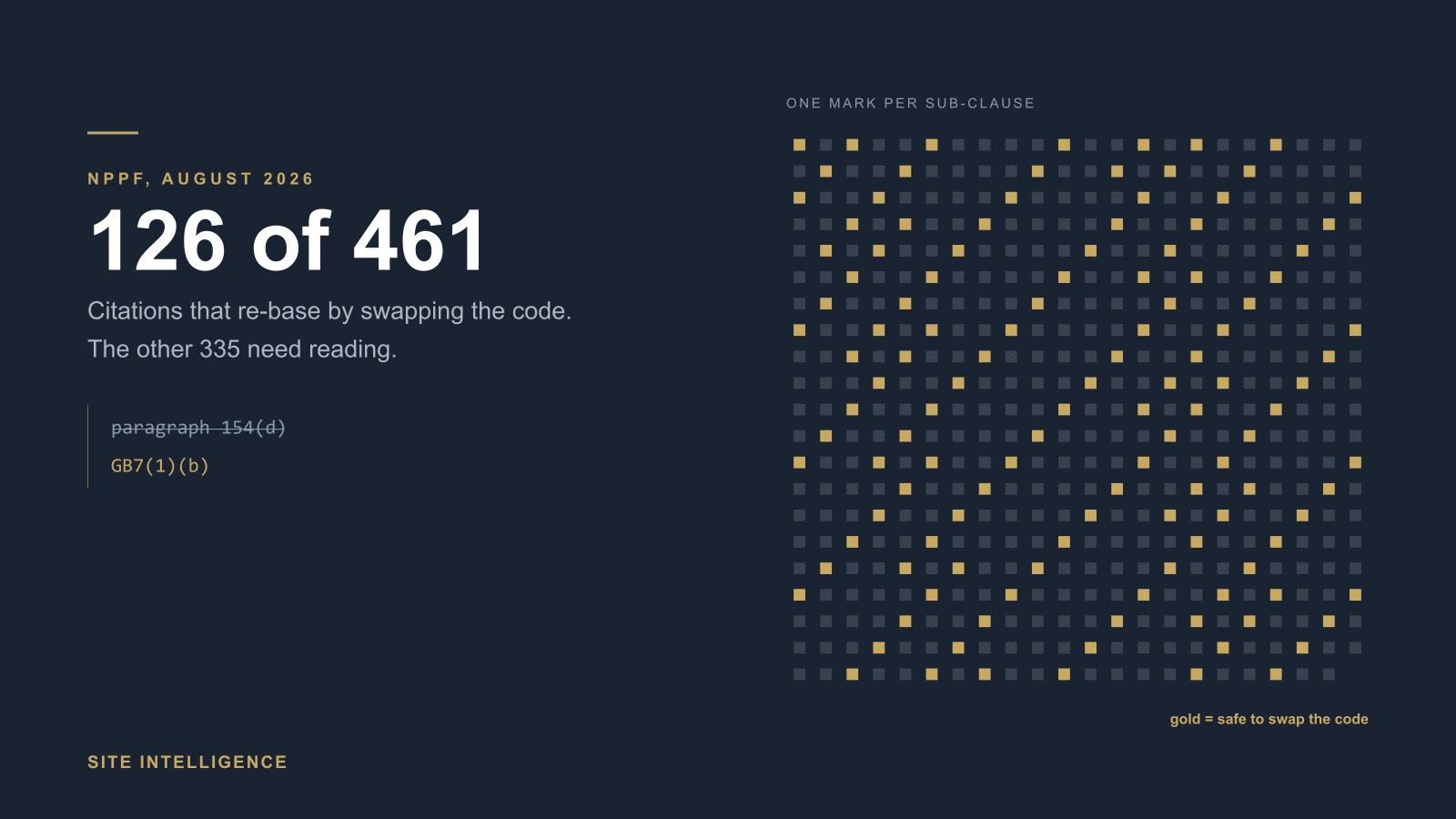
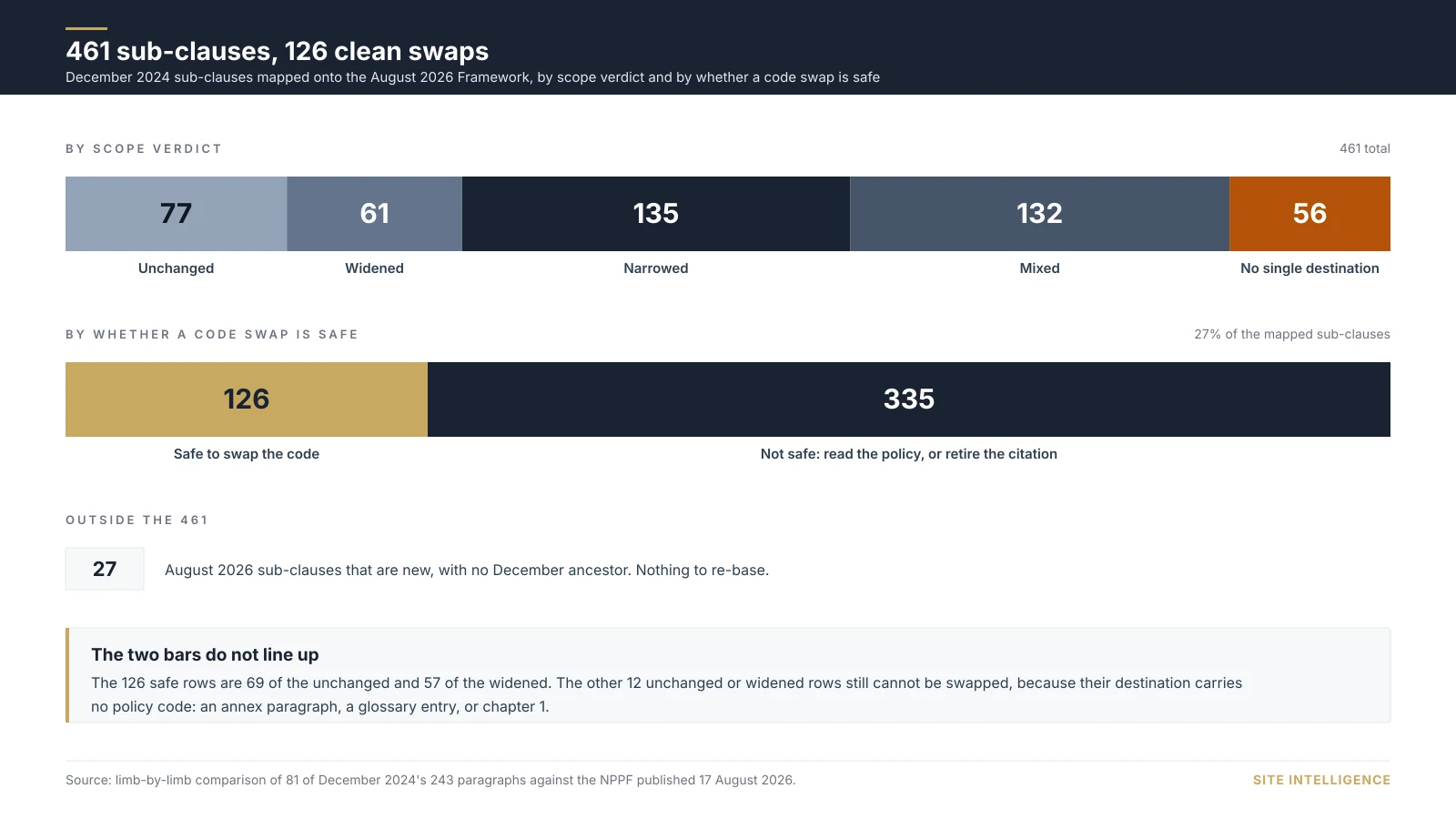
Of 461 December 2024 sub-clauses mapped onto the August 2026 Framework, only 126 re-base by swapping the code. The six traps, and how to work through them.
The August 2026 Framework replaced the continuous paragraph numbering of its thematic policies with policy codes, so the obvious first move is a find and replace across your templates, your precedent bank and your standard paragraphs. It is the wrong first move, and the reason is arithmetic rather than caution. Of 461 December 2024 sub-clauses mapped onto the new edition, 126 re-base by swapping the code. The other 335 changed scope, split across destinations, have no single citable successor, or cannot be re-based mechanically because their destination carries no policy code. A find and replace fixes the 126 and quietly certifies the rest.
Re-basing, in this piece, means taking a citation that points at a December 2024 paragraph and making it point at whatever now carries the same proposition, or retiring it where nothing does. Numbering did not disappear everywhere: chapter 1 still runs on numbered paragraphs, policies cross-refer internally to their own numbered paragraphs, and several annexes retain numbered paragraphs while others are set out as terms or tables. The Framework applies in England, which its own paragraph 1 states.
This is the second piece in the series on the Framework republished on 17 August 2026. The first set out how the new edition is built. This one is about the maintenance job that lands on anyone who keeps report templates, appeal precedents, standard objections or a citation library, and it is written to be worked through rather than read.
The arithmetic
The comparison behind these numbers runs limb by limb: 81 of December 2024's 243 paragraphs, broken into 461 sub-clauses, each one carrying the December wording, the August wording it maps to, and a verdict on whether the scope moved.
- 126 re-base by swapping the code alone.
- 135 narrowed.
- 132 are mixed, meaning parts widened and parts narrowed, or the clause split across more than one policy.
- 56 cannot be assigned a single operative destination to re-base onto.
- 12 more read as unchanged or widened but still cannot be re-based mechanically, because their destination carries no policy code at all.
Twenty-seven August 2026 sub-clauses are new, with no December ancestor. They sit outside the 461 because there is nothing to re-base.
That is a 27 per cent clean-swap rate. The figure most people carry in their head is closer to 100 per cent, which is what makes the mechanical approach so appealing and so expensive.
The sentence changed shape, not just its number
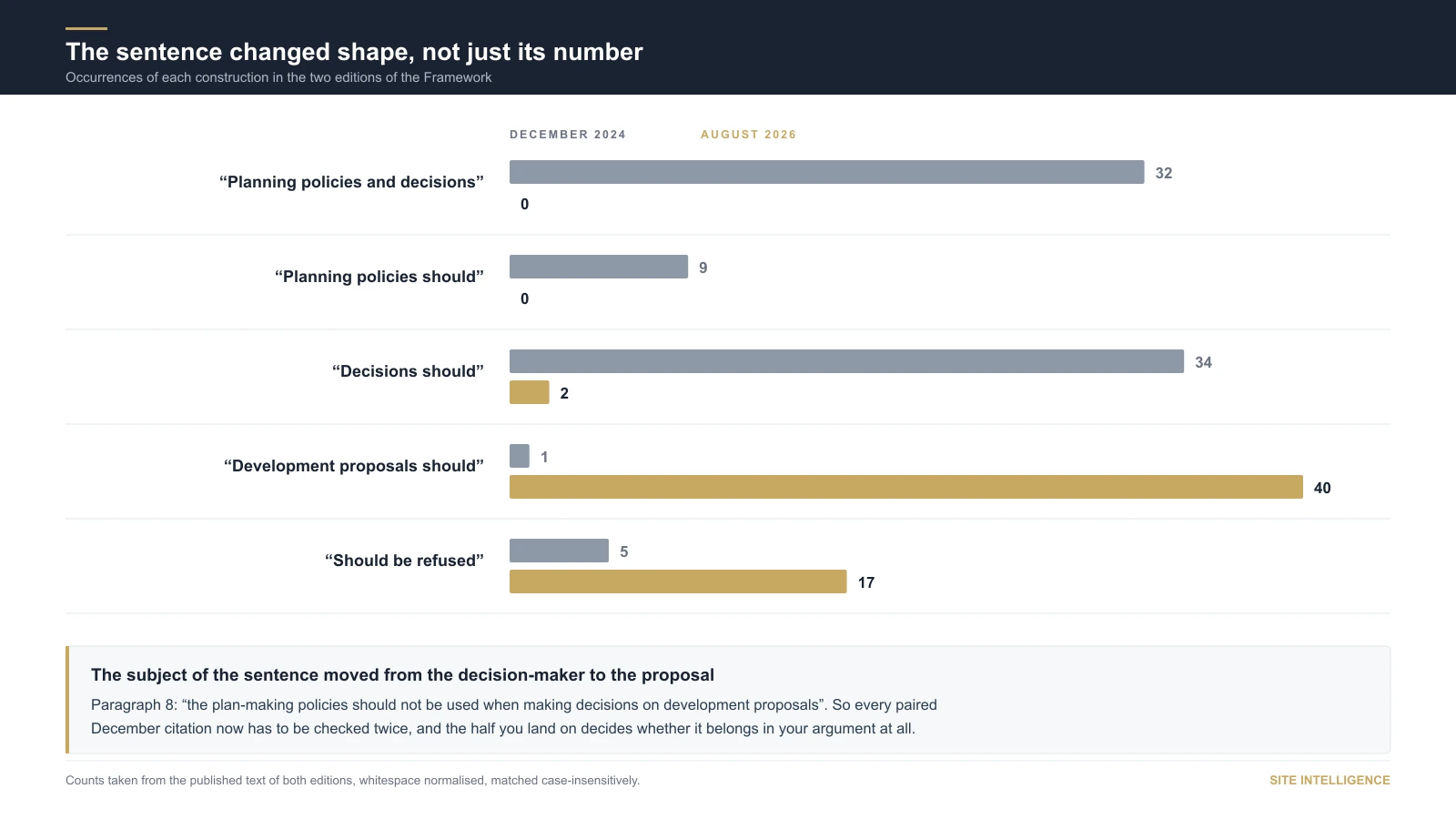
Before working through the traps individually, it helps to know why so many rows come back mixed. December 2024 was built on a paired formula. "Planning policies and decisions" opens 32 paragraphs in that edition. In August 2026 it returns zero. "Planning policies should" falls from 9 to zero, and "decisions should" from 34 to 2.
What replaced it is a different grammatical subject. "Development proposals should" runs from 1 occurrence in December 2024 to 40 in August 2026. "Should be refused" runs from 5 to 17.
So the December sentence typically told the plan-maker and the decision-taker to do something in a single breath. The August sentence usually tells you what the proposal must do, or what the outcome should be. Paragraph 8 then makes the separation express: "The thematic chapters contain both plan-making policies and national decision-making policies so that the approach to particular topics can be seen in the round. However, the plan-making policies should not be used when making decisions on development proposals."
For a citation library that has two consequences. Every paired December citation has to be checked twice, once for the plan-making half and once for the decision half, because the two halves went to different places and one of them sometimes went nowhere. And a citation lifted into a planning statement now has to survive the paragraph 8 test: if the code you have landed on is a plan-making policy, it cannot be relied on as an operative national decision-making policy, however well it fits.
Trap one: the quotation survives, the clause around it narrowed
This is the trap that beats proofreading, because the citation reads correctly. The words you quoted are still there, and the code you swapped in really does carry them. What moved is the clause they now sit inside.
December 2024 paragraph 154(d) allowed "the replacement of a building, provided the new building is in the same use and not materially larger than the one it replaces". GB7(1)(b) carries it almost word for word: "In the case of proposals for a replacement building, it should be for the same use and not materially larger than the one it replaces". Nothing in that quotation has changed. What has changed is that the first sentence of GB7(1)(b) now requires the existing building to be of permanent and substantial construction and lawful in planning terms. In December 2024 that permanence test attached to re-use, at paragraph 154(h)(iv), not to replacement.
One word can do it on its own. December 2024 paragraph 207 capped heritage information at "no more than is sufficient to understand the potential impact of the proposal on their significance". HE5(1) caps it at "no more than is necessary to understand the potential effect of the proposal on their significance". Sufficient became necessary, and impact became effect. Both are arguable in a hearing. Neither shows up in a search for the phrase you already had.
How to catch it. For every citation where the quotation still matches, read the whole policy the code sits in, not the limb. The 135 narrowed rows are almost entirely of this kind.
Trap two: the words are there, at another policy
Worse than a narrowing, because here the search actively reassures you.
The clearest example is the three tests for planning obligations. December 2024 paragraph 58 required obligations to be necessary to make the development acceptable in planning terms, directly related to the development, and fairly and reasonably related in scale and kind. In August 2026, "all of the following tests", "directly related to the development" and "fairly and reasonably related" each fall to zero occurrences. The first test does not. Search the new Framework for "necessary to make the development acceptable in planning terms" and you get exactly one hit, at DM6(1)(a).
DM6(1) is the list of tests for planning conditions. It is the successor to December 2024 paragraph 57, not to paragraph 58. Its neighbouring limb reads "Relevant to the development and to planning considerations generally", which is a lower bar than "directly related to the development", and no paraphrase of the proportionality test appears in DM6 at all. The obligations tests themselves remain statutory, at regulation 122(2) of the Community Infrastructure Levy Regulations 2010. For those three tests, cite regulation 122(2), subject to paragraph (2A). The regulation is not a restatement of the old direction: it governs whether an obligation may constitute a reason for granting permission, where December 2024 paragraph 58 governed whether one could be sought at all. The Framework is no longer where to cite the tests from.
Two smaller versions of the same trap. "Flexible approach" stands at 2 occurrences in each edition, so a count-based check reports it unchanged, but both August uses sit elsewhere, at HO8(3) on bedroom mix and TR4(1)(e) on parking, and the December use that mattered was paragraph 130(c) on daylight and sunlight, which has no successor. "Permission in principle" falls from 6 occurrences to 4, and none of the four directs anyone to use it.
How to catch it. When a phrase search returns a hit, do not stop at the hit. Read the policy heading above it and confirm it governs the same thing.
Trap three: policy, but no code
Paragraph 9 of the new edition states that "The annexes included with this Framework are also national planning policy". They carry no policy codes, so there is nothing for a code swap to land on, even where the wording is identical.
The five year supply buffers are the working example. December 2024 paragraph 78(a) and (b) set a buffer of "5% to ensure choice and competition in the market for land" or "20% where there has been significant under delivery of housing over the previous three years". Both survive, word for word, at Annex D paragraph 9(a) and 9(b). There is no code to cite. The correct citation is the annex and its paragraph, and the policy that uses the buffer points at it that way: HO3(1)(a)(i) requires a five year supply of specific deliverable sites "with an appropriate buffer (as set out in Annex D)".
That class is why 8 of the 77 rows marked unchanged, and 4 of the 61 marked widened, still cannot be re-based mechanically.
There is a second sub-class where the destination is not policy at all, and here the trap is that the sentence survives so convincingly. Chapter 1 carries the purpose of the planning system, the Brundtland formulation and the three objectives, largely unchanged in wording from December 2024 paragraphs 7 and 8. Paragraph 4 says of that chapter: "The chapter does not contain substantive policy; the policies to be used for plan-making and decision-making are set out in the chapters that follow." Paragraph 10 does the same to the boxed objectives at the head of each chapter, which "should not be applied as either plan-making or decision-making policy".
A Green Belt example shows how easily this is missed. December 2024 paragraph 142 opened the Green Belt chapter with substantive text: "The Government attaches great importance to Green Belts." The sentence survives almost intact in August 2026, as "The government attaches great importance to Green Belts, the essential features of which are their openness and permanence". It now sits in the chapter 13 objective box, which paragraph 10 excludes from application. The words are still there and still true. They are no longer an operative test you can put weight on.
You may still quote any of it as context. You cannot cite it as the policy your case turns on.
Trap four: no successor at all
Fifty-six of the 461 sub-clauses cannot be assigned a single operative destination for re-basing. That does not mean every underlying proposition has disappeared. Some were removed, some were redistributed across several policies with no one destination that can honestly be recorded, and some survive only as non-policy context.
They divide three ways: 36 where the December wording returns zero occurrences in August 2026, 17 redistributed, and 2 whose only near-verbatim survival is in text the Framework itself excludes from application.
Re-reading every one of the 56 against the August text, matching on stemmed word sequences so that a changed verb ending could not hide a survival, shows how one December limb can land in two places. The December objective of "significantly boosting the supply of homes" survives in operative policy at HO13(1): "To significantly boost the supply of homes, it is important that land with permission is developed without unnecessary delay." There the words are attached to build-out rather than carried as a general supply objective, so that use is recorded as narrowed. The general objective survives most closely in the chapter 6 objective box, which speaks of a substantial increase and which paragraph 10 excludes from application, so that part stays in this class. December paragraph 124's decision-taking duty on effective use of land survives almost word for word in the chapter 12 objective box, which paragraph 10 excludes from application, so it is context rather than redistribution.
That is the whole re-read, not a sample, and its limit is worth stating: a word-sequence probe finds surviving wording. It cannot find a provision that does the same job in entirely different words. That is the same standard the original mapping was built to, so the class is consistent with itself.
None of these 56 rows can be handled by citation substitution. Depending on which of the three they fall in, the old proposition has to be retired, reconstructed across several policies, or kept only as contextual material. Substituting a plausible-looking code is worse than deleting the sentence, because it produces a citation that survives a proofread and fails at the hearing.
A search list to run against your own live files, undetermined applications and templates. Every count below was taken from the published text of both editions.
| Phrase | December 2024 | August 2026 |
|---|---|---|
| safe and suitable access | 1 | 0 |
| less than substantial | 3 | 0 |
| all of the following tests | 1 | 0 |
| fairly and reasonably related | 1 | 0 |
| directly related to the development | 1 | 0 |
| most important for determining the application | 1 | 0 |
| prevented or refused on highways grounds | 1 | 0 |
| great weight | 6 | 0 |
| significant weight | 7 | 0 |
| valued landscape | 1 | 0 |
| First Homes | 4 | 0 |
| 5 units or fewer | 1 | 0 |
| planning performance agreement | 2 | 0 |
| light pollution | 1 | 0 |
| Regulation 19 | 10 | 0 |
| Regulation 22 | 3 | 0 |
| planning policies and decisions | 32 | 0 |
Two of those deserve a note, because they are the ones most likely to be quoted back at you. "Great weight" and "significant weight" both fall to zero, which does not mean the Framework stopped weighting things. It weights them in different words: "substantial weight" runs from 2 occurrences to 20. A template that says national policy attaches great weight to something is now quoting a formula the Framework no longer uses, and the replacement is not a synonym.
A hit on any of these is not automatically a defect. "Safe and suitable access" also appears in adopted local plan policies and in highway authority standing advice, and where your sentence rests on one of those it stands on its own terms. The check is what the sentence is citing, not whether the words appear.
Trap five: the sub-paragraph you cite may bring the rest of its list with it
Paragraph 11 of the August 2026 edition is new. There is no equivalent provision anywhere in December 2024, and the word "sub-paragraph" does not appear in that edition at all.
"Where policies in this Framework set out lists in the form of sub-paragraphs, all of those sub-paragraphs apply unless the text indicates otherwise (such as through the use of 'or' at the end of one or more sub-paragraphs)."
It does not make every list conjunctive, and reading it that way is its own error. Note the words "such as": an absent "or" is not the end of the enquiry, because a policy's language and structure can indicate alternatives just as clearly. GB7(1) is the obvious case. It opens "The following categories of development are not inappropriate in the Green Belt", and limbs (a) to (h) run without an "or" between them, but a replacement building under (b) plainly does not also have to be agriculture, village infilling, affordable housing and a station-related scheme at the same time. Categories are alternatives.
The real trap sits one level down. GB7(1)(g) opens "Development where all of the following apply", and then sets out (i) grey belt land which would not fundamentally undermine the purposes of the remaining Green Belt taken together, (ii) an evidenced unmet need for the type of development proposed, (iii) a sustainable location with particular reference to TR3, and (iv) compliance with GB8 in the case of major development involving housing. Citing GB7(1)(g)(i) for grey belt status does not isolate that limb. The opening words expressly require all four, so a case pleaded on (i) alone does not complete the test.
So before settling on a sub-paragraph citation, read the limb's parent for words like "all of the following", and read the list itself for whether it sets out alternatives. The distinction between conjunctive and disjunctive drafting always mattered. What paragraph 11 adds is an express Framework-wide default, and the burden now runs the other way: a list is read as cumulative unless something in it indicates otherwise.
Trap six: the December edition is still the right one, twice over
Two situations where re-basing a citation is the error.
Plans still on the old edition. Annex A(4) to A(8) route plans by the regime they are prepared under. A(4) sends local plans, minerals and waste plans and supplementary plans prepared under Part 2 of the 2004 Act as amended, with the 2026 local planning regulations, to the new Framework, and A(7) applies its policies to those plans "from 17 August 2026". A(6) keeps a neighbourhood plan submitted under Regulation 15 on or before the publication date on December 2024. A(8) is the catch-all: "Any other plans should be produced in accordance with the version of this Framework published in December 2024, unless any of the transitional arrangements in Annex 1 to that Framework apply". Establish which class the plan is in before you decide a citation has expired. Those instruments and their commencement sit outside a comparison of the two Frameworks, so check the plan rather than infer it.
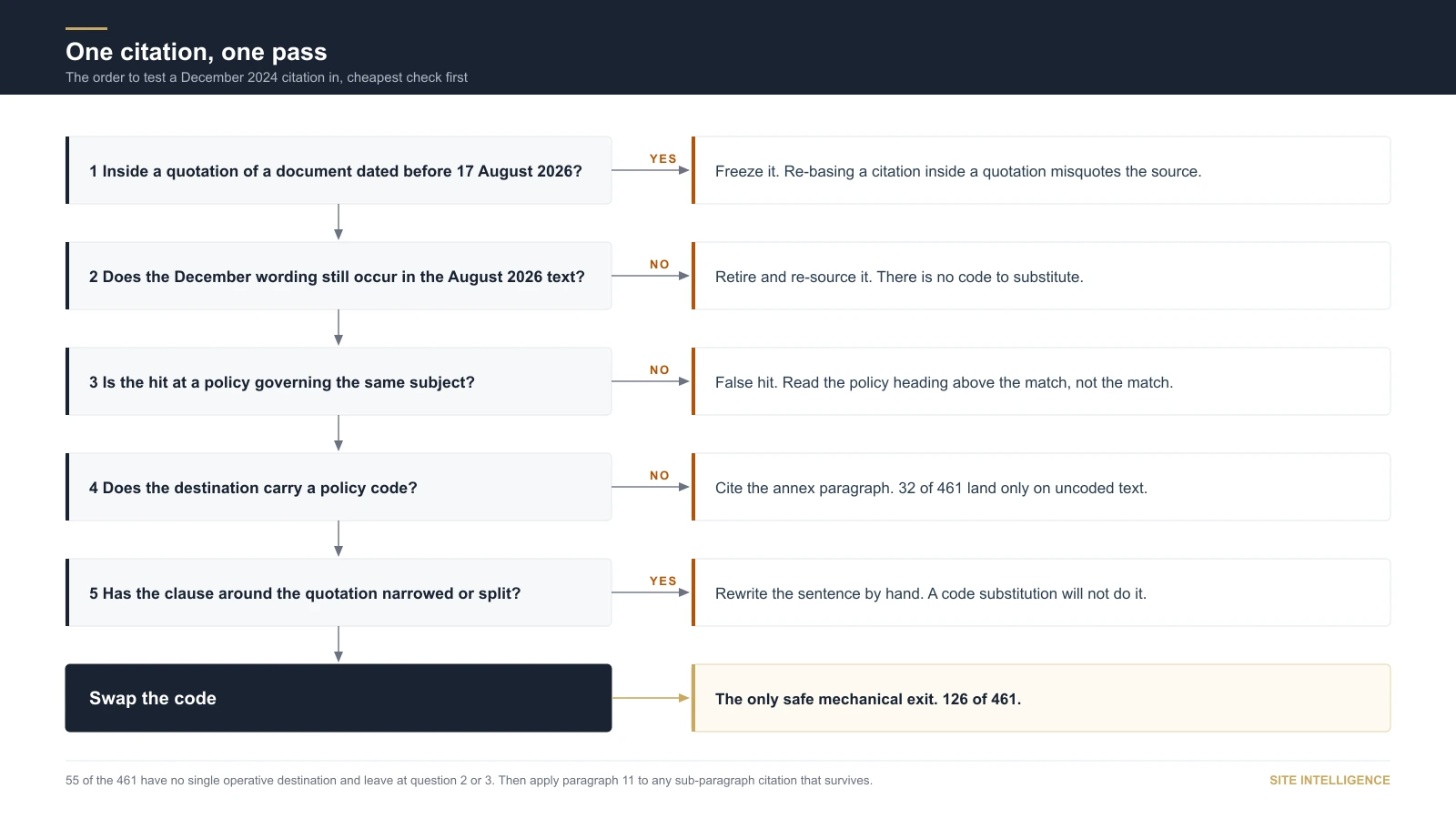
Anything you are quoting that predates 17 August 2026. An inspector's decision from 2025 cites the paragraph numbers that were current when it was written. So does a committee report, an officer's delegated report, a signed section 106 agreement, and your own issued advice. Re-basing a citation inside a quotation does not modernise the quotation, it misquotes the source. If your library holds appeal precedents, the rule is that the precedent's own citations are frozen, and only your commentary around them gets re-based. It is worth writing that down before anyone runs a bulk edit, because this is the one failure mode that turns a maintenance task into a fabricated citation.
Freezing the quotation does not freeze its relevance. In an undetermined application or a live appeal, preserve the historic words exactly, then reassess the proposition and your analysis around it against the August 2026 Framework. The quotation is evidence of what an inspector decided under the edition then in force. It does not establish what the current Framework requires.
A running order
1. Inventory before you edit. Search your templates, precedent bank and standard paragraphs for "NPPF" and for "paragraph", and list every citation with its file and line. You want a baseline register before you start, because it is the only thing you can reconcile against at the end.
2. Split the list in two. Historic quotations, meaning anything inside a quotation of a document dated before 17 August 2026, go into a frozen set that nobody edits. Everything else goes into the working set.
3. Classify the working set against the traps above before changing anything. Cheapest first: run the phrase searches in trap four and flag what they return for source verification. No sentence should be retired because its wording has left the Framework, only because the sentence was resting on the Framework for it.
4. Re-base the clean ones, and read the whole policy for the rest. A narrowed or mixed row needs the sentence rewritten by somebody qualified to write it, not a code substituted into it.
5. Apply the paragraph 8 test to every citation going into a decision-side document, and the paragraph 11 test to every sub-paragraph citation.
6. Reconcile, do not count down to zero. A search for "NPPF" and "paragraph" will always return hits: valid annex citations, frozen historic quotations, chapter 1 references, properly rewritten commentary, and uses of the word that have nothing to do with the Framework. The completion test is that every entry in the original inventory carries a recorded outcome, one of retained as a historic quotation, cleanly substituted, rewritten, re-sourced, retired, or escalated to someone else. Then re-run targeted searches for December 2024 references that are still unresolved.
Step 6 is the one people skip, and it is the one that tells you whether the job is done. A zero on a keyword search will not tell you that. A reconciled inventory will.
What this does not cover
The limb-by-limb comparison behind the counts covers 81 of December 2024's 243 paragraphs. Silence about a December topic here means it was not examined that way, not that nothing moved. Eight of the 19 families are likeliest to be under-read on that account.
The comparison evidences nothing outside the two Frameworks. It does not reach the Community Infrastructure Levy Regulations beyond the single point made above, the biodiversity net gain regime, planning practice guidance paragraph references, or case law. I can tell you that a sentence has left the Framework. Where I have not gone outside the pair, I cannot tell you where the proposition it carried now stands.
The occurrence counts are taken from the published text of both editions with whitespace normalised and hyphenation across line breaks repaired, matched case-insensitively. A phrase count is evidence about wording, not about meaning, which is why every count above is paired with the policy it points at.
One job this week
Take your three most-used templates, not your whole library, and run the seventeen phrases in the table above against them. That is a short exercise with a definite end, and it will tell you within an hour how much of the larger job you actually have. Whatever it returns is the honest starting number for everything else.
Next in this series: Green Belt and grey belt after August 2026, where the exception list survived and the tests around it did not.
Ready to get started?
Complete desktop planning intelligence for any site in England. From £295.