Planning & Regulation 26 August 2026Updated 3 October 2026 33 min read
The August 2026 NPPF: 19 Families, 131 Policies, and What Actually Changed
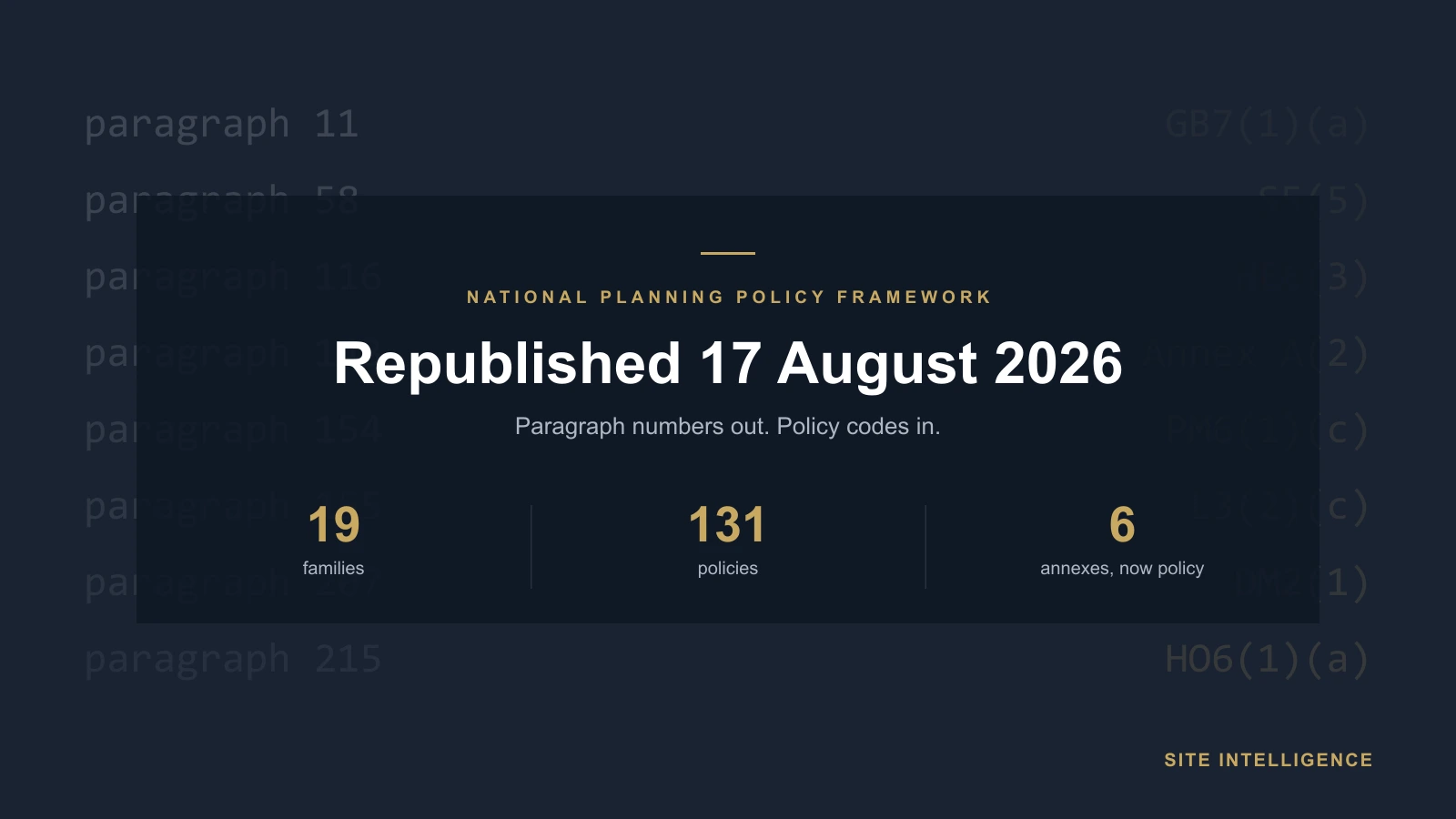
The Framework republished on 17 August 2026 dropped continuous paragraph numbering, split its policies in two, and made all six annexes national policy.
The National Planning Policy Framework applies in England. The edition republished on 17 August 2026 abandoned continuous paragraph numbering across its thematic chapters, split its policies into a plan-making set and a decision-making set, directed that plan-making policies should not be used in decisions, and made all six annexes national planning policy. I mapped 461 December 2024 sub-clauses, drawn from 81 of that edition's 243 paragraphs, onto the new text: of those 461, 405 have an identified destination, though 32 of the 405 land only on uncoded text that cannot be cited as policy; only 126 are clean citation substitutions, 279 changed scope or structure, and 56 cannot be assigned a single operative destination for re-basing. This is what I would change in a standard planning file this week, and what I would stop asserting. One term, used throughout and meant strictly. "No single operative destination" means I could find no one provision in the August 2026 text to re-base the citation onto: the December 2024 wording is not carried forward anywhere I could find, and nothing performs a comparable function in a single place on a reading of both editions. Some of that class was removed outright, some was redistributed across several policies, and some survives only as non-policy context. It is a statement about what this comparison found, not a finding that nothing does the job. Where a provision has moved rather than gone, I say where it landed.
How to read the August 2026 edition
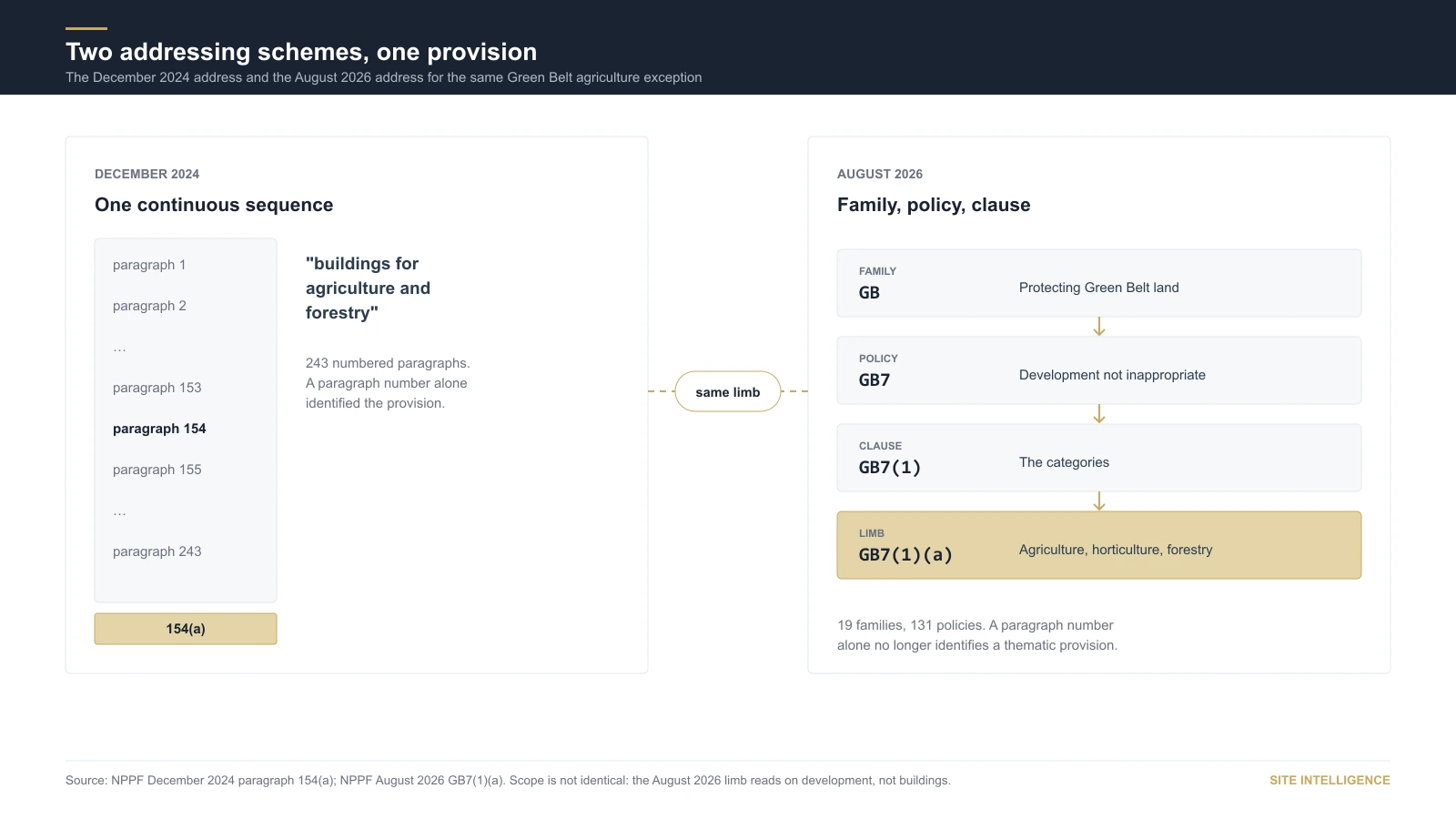
Thematic provisions can no longer safely be cited by a bare paragraph number, and the exceptions matter as much as the rule. Chapters 2 to 20 are addressed by policy code and clause. Chapter 1, the three opening paragraphs of chapter 2, and the annexes still carry numbered paragraphs and are cited that way, but name the chapter: chapter 2's openers restart at 1, so a bare "paragraph 2" is ambiguous between chapter 1's plan-led direction and chapter 2's list of the optional parts of a development plan. Chapter 3 carries none before DM1, so bare paragraph numbers here are chapter 1's. And a December 2024 paragraph number remains correct for the residual class of plans Annex A(8) leaves on that edition.
December 2024 ran one continuous sequence, paragraphs 1 to 243, which August 2026 abandons. Chapter 1 states it carries no substantive policy. Chapters 2 to 20 hold 19 policy families and 131 policies. Numbering restarts inside each policy and again in Annexes A, D, and E, so a bare paragraph number no longer identifies a thematic provision. The citation unit is a policy code and its internal clause: GB7(1)(a), S5(4), HE6(6), Annex A(2). Policies do still have numbered internal paragraphs, and the Framework cites them that way itself: HE6(3) directs that harm "should be dealt with in accordance with paragraphs 4 to 6 of this policy". What has gone is the edition-wide sequence that made a number self-locating, so the number now needs its policy code in front of it.
Every occurrence count below was taken across the complete text of both editions, footnotes and annexes included.
Paragraph 5 puts the procedural policies in chapters 2 and 3, has the thematic chapters separate plan-making from decision-making, and provides that "Taken together, the policies for decision-making (both procedural and thematic) comprise a set of national decision-making policies."
Paragraph 6 has the plan-making policies "read as a whole (including relevant footnotes and annexes)", and paragraph 7 says the same of the national decision-making policies. December 2024 gave one direction for the lot: "The Framework should be read as a whole (including its footnotes and annexes)." That whole-document reading is gone. "Planning policies and decisions" falls from 32 occurrences in December 2024 to zero in August 2026, and "national decision-making policies" runs from zero to 39, of which 17 are chapter sub-headings.
Paragraph 8 is the firewall, my word rather than the Framework's: "The thematic chapters contain both plan-making policies and national decision-making policies so that the approach to particular topics can be seen in the round. However, the plan-making policies should not be used when making decisions on development proposals." It runs one way on its face, barring plan-making policies from decisions and saying nothing about the reverse, but the plan-making set is not sealed off. PM6(1)(c) requires plan-makers not to include policies which "duplicate, substantively restate or are inconsistent with the content of national decision-making policies, unless directed by other policies in this Framework". The plan-making direction is chapter 1 paragraph 2, which names the plan-making policies alone, and Annex A(2) does not supply one: it sits under Annex A's heading "For the purposes of decision-making" and fixes the weight a decision-maker gives a plan policy. So it is a reason for a plan-maker to read the decision-making set, not a requirement to. Each of the 17 thematic chapters carries a "National decision-making policies" sub-heading and 16 of the 17 a "Plan-making policies" sub-heading, so every citation must say which side it came from.
The annexes are policy now
Paragraph 9 is 11 words long and relocates policy: "The annexes included with this Framework are also national planning policy." December 2024 said only that they formed part of what you read. What that means in a decision still turns on paragraph 7, which has the decision-making set read with "relevant" annexes.
The count moved from 3 to 6. December 2024 carried Annexes 1 Implementation, 2 Glossary, and 3 Flood risk vulnerability classification. August 2026 carries A Implementation, B Glossary, C Information requirements, D Housing calculations and supply, E Green Belt assessments, and F Managing flood risk and coastal change.
Annex B is the glossary and carries no policy code, so cite the annex and the term. Counting bold headwords in the first issue of 17 August 2026, it holds 129 defined terms against December 2024's 106, with 37 added and 14 removed. Of the 92 terms common to both editions on that count, 54 are unchanged in wording and 38 are not. Renames account for 8 of the apparent additions and removals, so a raw count overstates both sides. GOV.UK's re-issue of the PDF on 17 September 2026 changed "investigation" to "assessment" in two headwords carried over word for word from December 2024: "Site investigation information" and "Competent person (to prepare site investigation information)".
Annex C schedules information requirements in 18 rows naming 15 of the 131 policies, with 9 of the 19 families carrying no row. DM2(1) makes the specified policy information the floor of every validation list, Annex C summarising it, DM2(2) the ceiling. December 2024 had no annex of this kind, so I record Annex C as provisionally without antecedent.
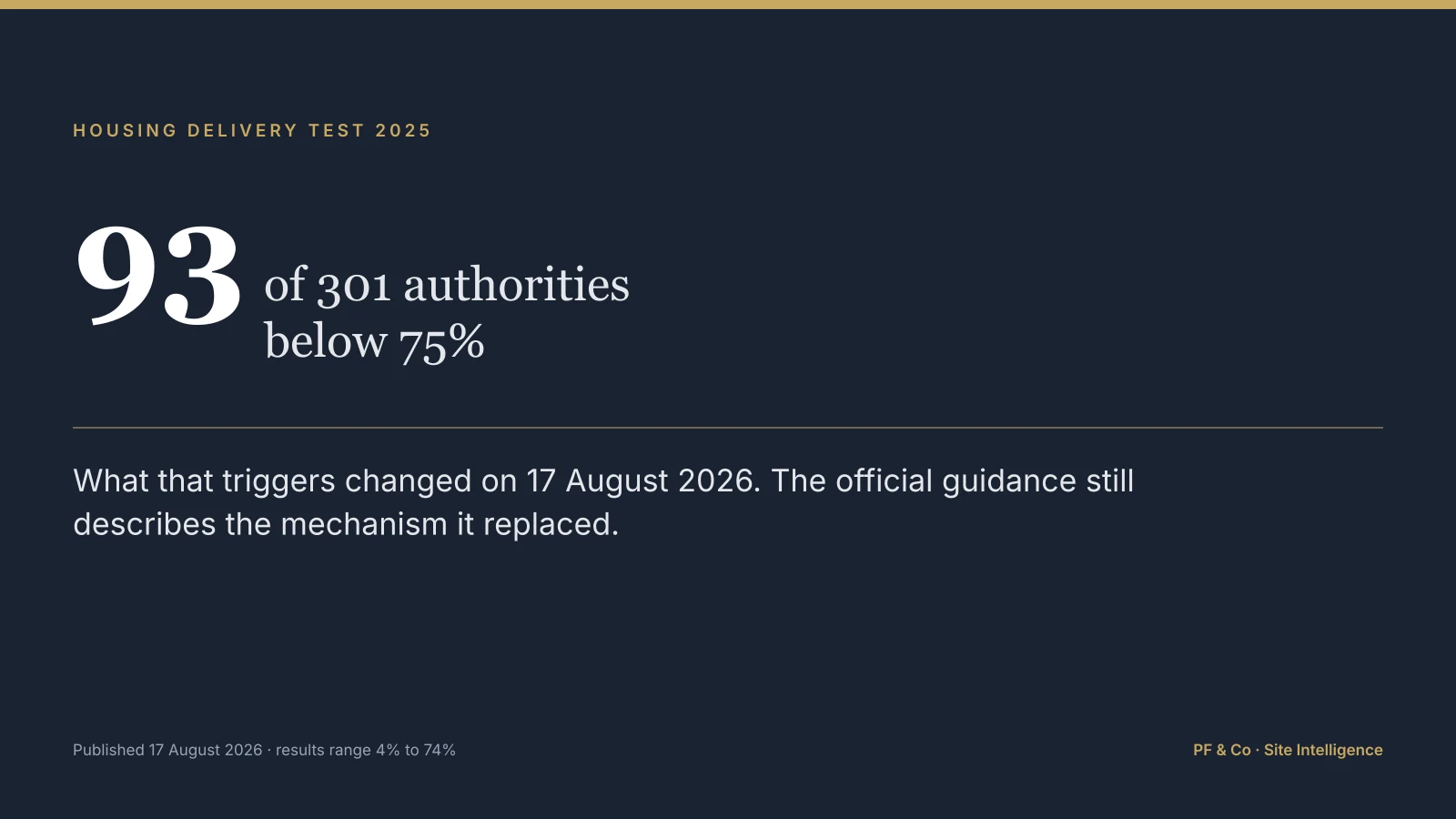
Annex D holds the standard method and the five-year supply buffers, and its D(12)(c) deems "an evidenced unmet need for housing" to exist, for S5(1)(j) alone, where delivery falls below 75% of the requirement over three years. Footnote 41 separately treats a Housing Delivery Test result below 75% as evidenced unmet need for housing under the grey belt test at GB7(1)(g)(ii).
Annex E supplies a method for Green Belt assessment and grey belt identification, grading each assessment area Strong, Moderate, or Weak or None against Green Belt purposes (a), (b), and (d). Paragraph 9 makes it national planning policy, but it is drafted as the method for the plan-making assessment GB2(3) requires, contains no direction to a decision-maker, and must be set against paragraph 7's "relevant" annexes. Whether an applicant assessing grey belt under GB7(1)(g)(i) must follow Annex E is unresolved on the face of the text, and I flag rather than resolve it. The risk is not symmetrical. Grading your assessment areas against Annex E and recording that you have costs an appendix. Leaving it out creates an avoidable vulnerability if the decision-maker treats Annex E as relevant national policy under paragraphs 7 and 9. Neither text tells you how that would be weighed, which is the point. So until this is tested I would follow Annex E and say plainly that I have, as a precaution rather than a concession.
Annex F carries three tables, and F6(1)(a) makes one decisive: proposals "should be refused if the use is incompatible with the risk from river or sea flooding, as set out in Annex F, table 3".
Weight, refusal, and two reading rules
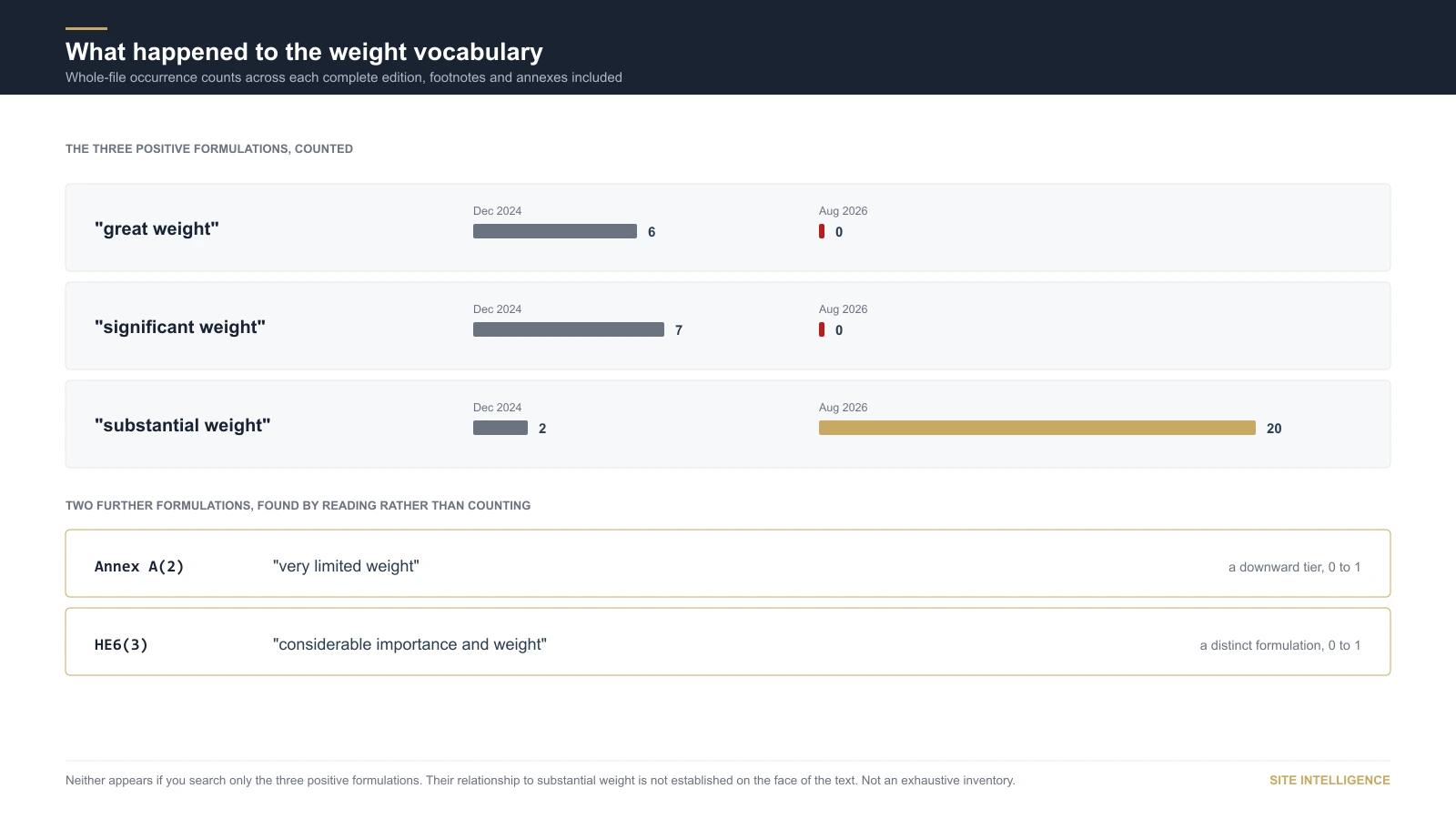
Re-check every submission that turns on a weight adjective. "Great weight" falls from 6 occurrences in December 2024 to zero in August 2026 and "significant weight" from 7 to zero, while "substantial weight" rises from 2 to 20. The three positive formulations resolve to "substantial weight" alone, which is not benefits-only: GB6(2) weights Green Belt harm, HE6(1) heritage conservation.
No count of phrases can settle whether the scale narrowed. A downward tier sits at Annex A(2), where policies "materially inconsistent with national decision-making policies in this Framework should be given very limited weight", zero occurrences to 1. HE6(3) adds another, any harm to a designated heritage asset being "a matter of considerable importance and weight", also zero to 1.
Paragraph 7 announces the second convention, some policies naming "the limited circumstances in which it is expected that permission would be refused". Those circumstances are countable. "Should be refused" runs from 5 occurrences in December 2024 to 17 in August 2026, and "should be approved" from 1 to 7. Of the 17, 14 are refusal directions in 12 policies: TC3, M5, L3, DP3, TR6, HC5, F6, F7, N2, N4, N6, and HE6, with M5 and N6 carrying two each. Two of the 17 are cross-references, at S4(2)(c) and S5(2). One of the 17 sits in the key to Annex F table 3.
The cross-references do the wider work. S4(2)(c) does not switch S4(1) off: it names failure to comply with "one of the national decision-making policies which state that development proposals should be refused in specific circumstances" as one situation in which benefits are "likely to be substantially outweighed by adverse effects". The refusal direction still stands in its own policy, and F6(1)(a) shows one written to be decisive.
Two reading rules govern all of it. Paragraph 11 sets the default: "Where policies in this Framework set out lists in the form of sub-paragraphs, all of those sub-paragraphs apply unless the text indicates otherwise (such as through the use of 'or' at the end of one or more sub-paragraphs)". A case resting on one limb must now show the list is disjunctive. Paragraph 10 then empties the boxes, short objectives in boxed text being "for context only and should not be applied as either plan-making or decision-making policy". The chapter 13 box reads "The government attaches great importance to Green Belts, the essential features of which are their openness and permanence", which December 2024 carried materially as numbered paragraph 142, in the policy body. It is now quotable for context, not as a test.
Not everything moved, so check where a familiar sentence has landed before assuming it is gone. HO13(1) still carries "To significantly boost the supply of homes, it is important that land with permission is developed without unnecessary delay."
The presumption is now a map to a test
The routing question, by which I mean which policy you are sent to before any balance is struck, is now geographic, though the word itself survives: "presumption" falls from 12 occurrences in December 2024 to 3 in August 2026, and S3 is titled "Presumption in favour of sustainable development", so the heading above is the Framework's word rather than mine. The December 2024 paragraph 11(d) balance has no single one-to-one successor. Comparable functions are redistributed across S4 and S5, while the former out-of-date-policy trigger and the weighting rider have no identified successor at all. "Tilted balance" occurs zero times in both editions, so it is a practitioner term throughout this article, and nothing bearing that name was deleted or amended. S3(1) does the routing: policy S4 applies "when considering development proposals within settlements"; "Outside settlements, policy S5 should be applied"; and "In all locations, development proposals that accord with both an up-to-date development plan and the decision-making policies in this Framework should be approved without delay." Where a site straddles the line, S3(2) applies S4 and S5 to the relevant parts before an overall view.
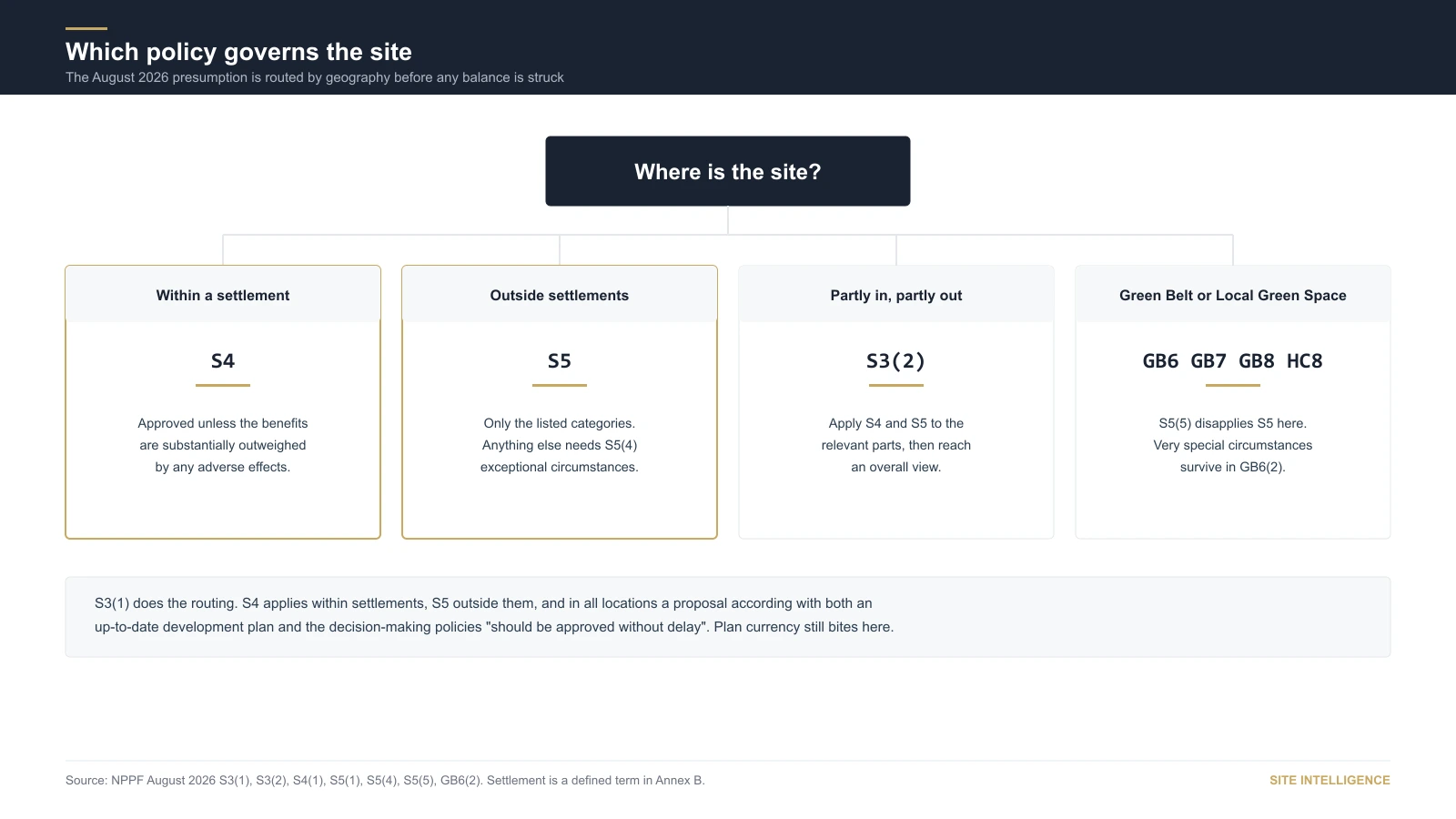
Inside a settlement, S4(1) is expansive: proposals "should be approved unless the benefits of doing so would be substantially outweighed by any adverse effects, when assessed against the national decision-making policies in this Framework." S4(2) names three limbs in which that outcome is likely. At S4(2)(a), substantial adverse impact on an allocation or safeguarding, or on the five policies named at S4(2)(a)(ii). At S4(2)(b), the whole or partial loss of undeveloped land used for a cemetery or burial ground, or for water storage or flood risk management, unless compensatory provision is made that does not increase flood risk on or off-site. At S4(2)(c), failure to comply with one of the refusal directions above. The chapeau makes the list non-exhaustive, so clearing all three limbs is not enough.
Outside, S5(1) is a closed list: "Only certain forms of development should be approved outside settlements", 10 limbs, a to j, each carrying the same substantially-outweighed standard. Anything off the list falls to S5(4), approval "only in exceptional circumstances, where the benefits of the proposal would substantially outweigh the adverse effects, including to the character of the countryside and in relation to promoting sustainable patterns of movement". Neither text establishes how that second head, on sustainable patterns of movement, will be applied. Isolated homes go to S5(3) and HO11.
S5(5) lifts Green Belt and Local Green Space out of the routing, sending them to "policies HC8, GB6, GB7 and/or GB8 (as appropriate)". Read its second sentence: where development would not be inappropriate under HC8 or GB7, the S5 approval expectation returns, applying S5(2). Inappropriate development stays with GB6(2), very special circumstances, and substantial weight to Green Belt harm.
S6 is the fourth route. Conflict with a neighbourhood plan makes adverse effects likely to substantially outweigh the benefits of any housing proposal, provided the plan joined the development plan five years or less before the decision and "contains allocations to meet its identified housing requirement". December 2024 gated that on paragraph 11(d) being engaged first. S6 does not.
A great deal turns on one word. Settlement is defined in Annex B. I found no antecedent term in December 2024's glossary, but the glossary was compared by headword rather than mapped clause by clause, so that is a weaker finding than the sub-clause work elsewhere in this piece. The definition includes "land which is allocated or has permission for development which will form part of the built-up area once the development is complete". It excludes two things on unlike terms, and the difference decides routing. Hamlets and scattered groups of houses outside predominantly built-up areas are excluded "unless specifically defined as a settlement in the development plan". Villages "which lie within and are defined as part of the Green Belt in the development plan" are excluded outright. Only the second exclusion is absolute, so read the plan before advising that a hamlet takes the S5 route.
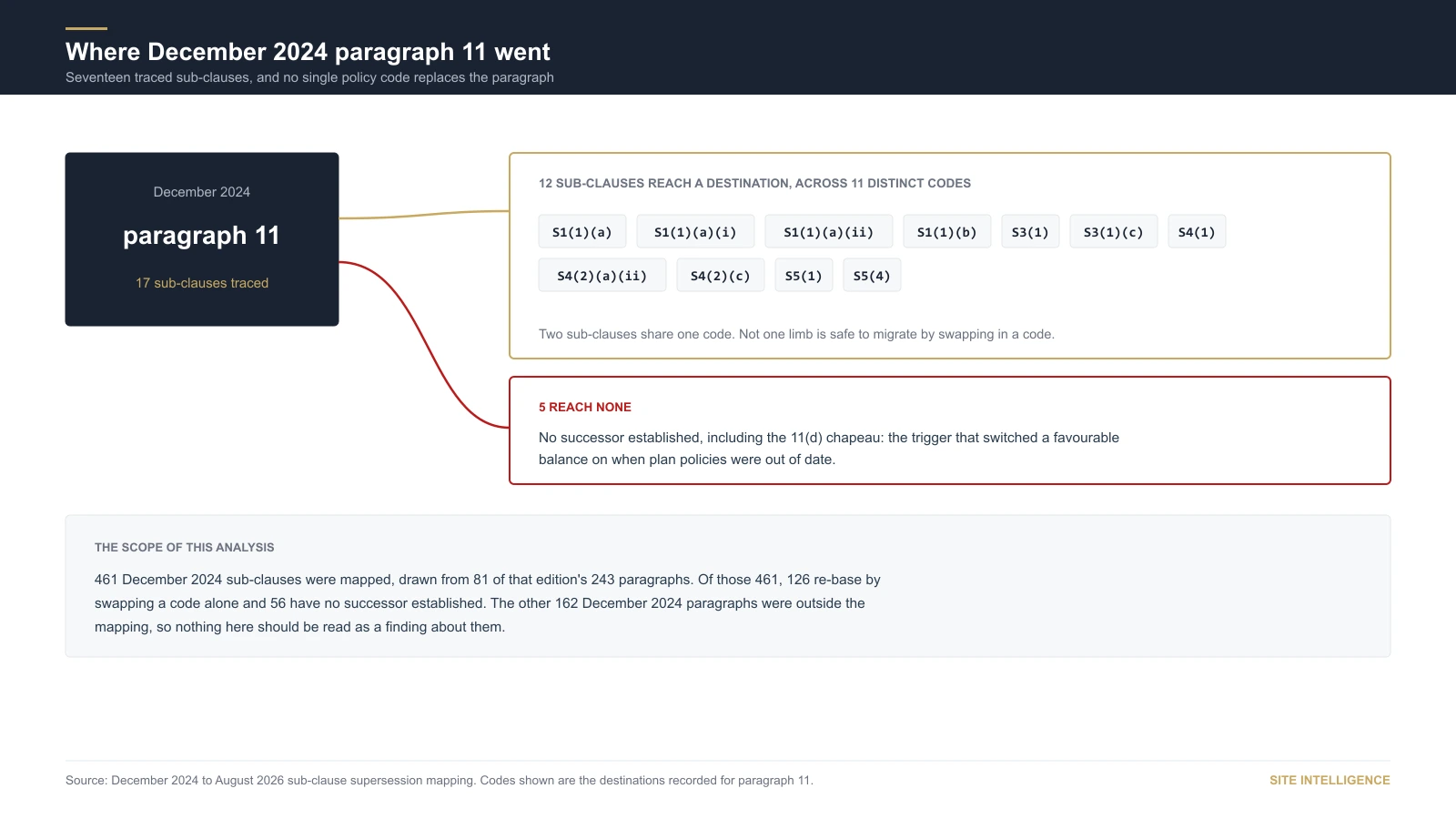
December 2024 paragraph 11 has no single successor. It has destinations: eleven policy codes across twelve of its seventeen traced limbs, every one of them in family S. The point is not that paragraph 11 vanished but that no one code stands in for it. Five of the 17 reach none, among them the plan-making half of the chapeau, the align-growth-and-infrastructure limb, the December 2024 11(d) trigger, and the 11(d) weighting rider. Two of the 17 re-base safely by swapping a code.
December 2024 limb 11(d), the tilted balance, accounts for 7 of the 17 and lands on 5 destinations: S4(1) within settlements, S5(1) for listed development outside, S5(4) for unlisted development outside, S4(2)(a)(ii) for five protective policies, and S4(2)(c) for the remainder. December 2024's footnote 7, marked at 11(b)(i) and 11(d)(i), listed habitats sites and SSSIs, Green Belt, Local Green Space, National Landscapes, National Parks and the Broads, Heritage Coast, irreplaceable habitats, designated heritage assets, and areas at risk of flooding or coastal change. S4(2)(a)(ii) carries no footnote and names five policies in its body: HC7, HC8, N6, N4, and L2(1)(d). Irreplaceable habitats survive there, since that clause names "areas of particular importance for biodiversity and geodiversity (N6)", and N6 reaches habitats sites and SSSIs at (1) and directs refusal at (2) for "the loss or deterioration of irreplaceable habitats". Absent are Green Belt, designated heritage assets, flood or coastal risk, and Heritage Coast outside a Protected Landscape. The old list survives, two cross-references lighter, as August 2026 footnote 24, but its marker sits at S1(1)(a)(i) alone, a plan-making limb. Cite S4(2)(a)(ii) for a heritage or flood-risk objection and there is nothing there. Not one of the 7 re-bases safely by code. The two landing nowhere are the trigger, "the policies which are most important for determining the application are out-of-date", and the rider on "particular regard to key policies".
"Most important for determining" falls from 1 occurrence in December 2024 to zero in August 2026, "significantly and demonstrably" from 3 to zero, and "substantially outweighed" rises from zero to 6. The words of the December 2024 11(d) trigger have gone, with no identified successor. Plan currency still bites elsewhere: S3(1)(c) reserves approval without delay to proposals that accord with an up-to-date development plan, and the Annex A(3) protection against a housing need figure counting as unmet need runs only for five years from adoption.
Annex A: what weight your development plan now carries
"Development plan policies (or parts of those policies) which are materially inconsistent with national decision-making policies in this Framework should be given very limited weight. The only exception to this is where they have been examined and adopted or made against this Framework. Other development plan policies should not be given reduced weight simply because they were adopted prior to the publication of this Framework."
December 2024 paragraph 232 ran a sliding scale instead: "Due weight should be given to them, according to their degree of consistency with this Framework". "Due weight" falls from 1 occurrence to zero, while "materially inconsistent" rises from zero to 1.
Three consequences. The threshold is a materiality judgement rather than a switch: a policy is either materially inconsistent with the national decision-making policies, in which case it drops to very limited weight, or it is not, and "materially" is for the decision-maker to judge. Very limited weight is not no weight, and where this Framework means nil it says so, as N2(3) does with "should not give weight". None of it displaces the statutory starting point, which chapter 1 paragraph 3 restates as "Planning law requires that applications for planning permission be determined in accordance with the development plan, unless material considerations indicate otherwise", with footnote 2 confirming that the Framework "does not displace the statutory obligations placed on decision-makers by virtue of, among other things, section 38(6) of the Planning and Compulsory Purchase Act 2004". It operates below policy level, because "or parts of those policies" makes the clause the unit, so a materially inconsistent part should receive very limited weight while Annex A(2) does not itself determine the weight of the remainder, which is assessed on its own terms. And the saving is narrow, covering only plans examined and adopted or made against the August 2026 edition, so a plan adopted in 2025 against December 2024 takes nothing from it.
The third sentence is the counterweight, easy to miss behind the exception. Read what it actually bars: "Other development plan policies should not be given reduced weight simply because they were adopted prior to the publication of this Framework." Age alone is expressly not a reason to reduce weight, and that is the whole of it. Clearing the materiality threshold does not fix a policy's weight, and other provisions still bite: N2(3) directs decision-makers not to give weight to plan policies requiring biodiversity gains beyond the statutory framework, whatever their date. Footnote 67 extends the age point to made neighbourhood plans.
The modal hardened too. December 2024 paragraph 231 said the policies "should be taken into account in dealing with applications". Annex A(1) says they "must be taken into account in decision-making from the day of its publication". I found no saving in Annex A for applications or appeals undetermined on 17 August 2026, and whether anything outside the Framework saves them is beyond this comparison.
Annex A(3) narrows that protection. Where an authority demonstrates five-year supply with the appropriate buffer and delivery above 75% on the Housing Delivery Test, a local housing need figure above the adopted requirement is not evidence of unmet need, but only "for the purposes of policy S5(1)(j)", and only for five years from adoption.
Plan-making is re-cut by legislative regime, not examination stage. "Regulation 19" falls from 10 occurrences in December 2024 to zero in August 2026, and "Regulation 22" from 3 to zero. Annex A(4) and A(5) route plans by the regime they are prepared under, A(4) naming Part 2 of the 2004 Act as amended with the 2026 local planning regulations, and A(5) sending spatial development strategies to this Framework, both applying from 17 August 2026 under A(7). Under A(6) a neighbourhood plan submitted under Regulation 15 by publication stays on December 2024; any not submitted "must comply with this Framework". Those instruments, their commencement, and Regulation 15 sit outside this comparison and are unverified here.
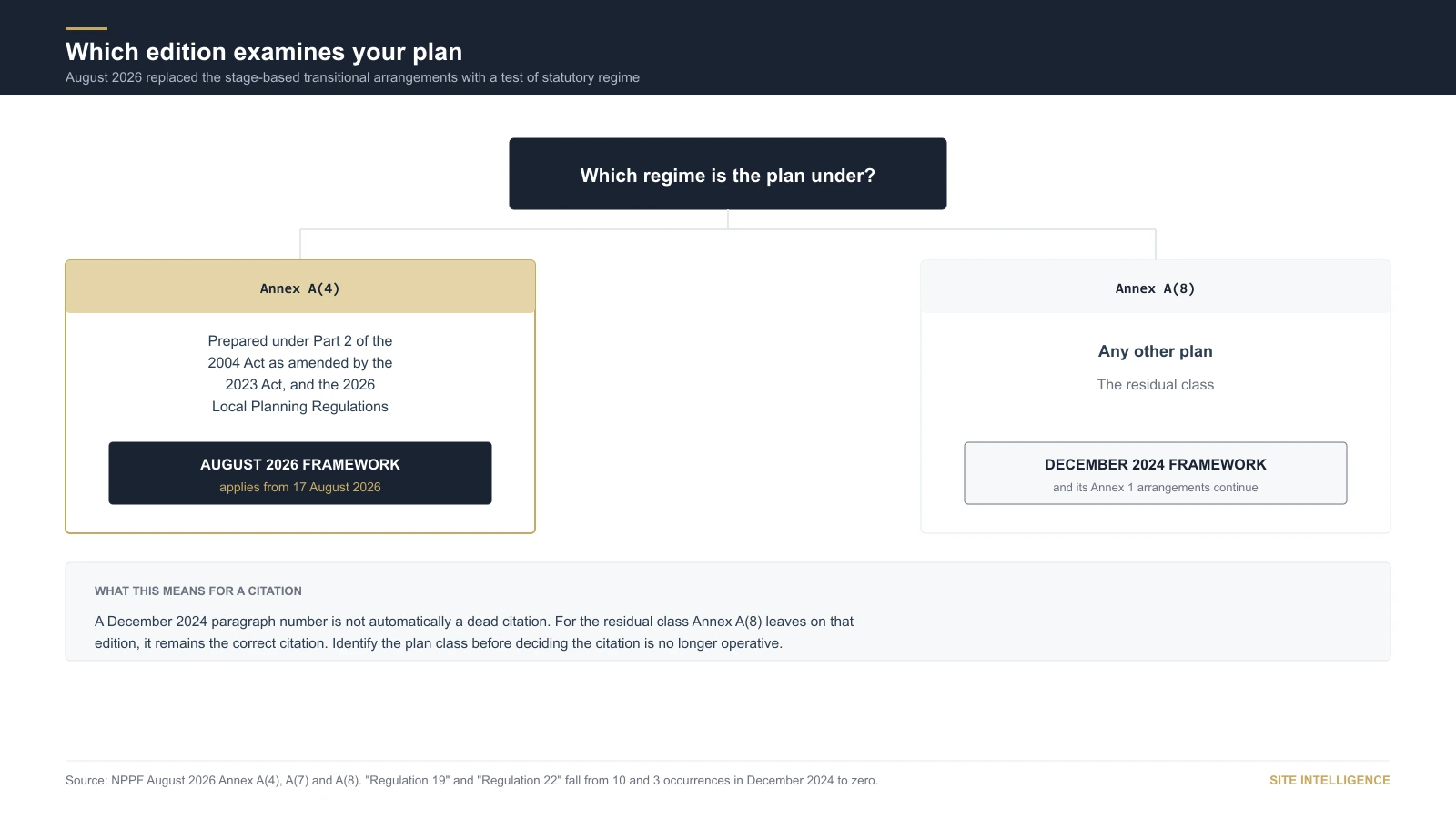
Then Annex A(8), the clause to have to hand before treating a December 2024 citation as dead: "Any other plans should be produced in accordance with the version of this Framework published in December 2024, unless any of the transitional arrangements in Annex 1 to that Framework apply (in which case those transitional arrangements continue to apply)." For that residual class the December 2024 edition remains operative, with its own stage-based transitional scheme.
One quotation and five propositions to re-check
Loss needs a denominator. The comparison covers 81 of December 2024's 243 paragraphs, broken into 461 sub-clauses, of which 405 have an evidenced destination in August 2026 and 56 cannot be assigned a single operative destination for re-basing. Loss analysis therefore rests on a third of the old Framework, and silence about a December 2024 topic means unexamined, not unchanged. Each of the six below was checked separately against the complete text of both editions. Item 1 is verbatim December 2024 wording; the other five are propositions practitioners run rather than sentences the Framework carried, and take no quotation marks.
1. Verbatim, December 2024 paragraph 115(b): "safe and suitable access to the site can be achieved for all users". "Safe and suitable access" falls from 1 occurrence to zero and "suitable access" from 1 to zero, and there is no identified general successor. The nearest wording on access is L2(1)(d)(ii), "Maintain safe access and egress for occupiers and users", but it reaches only L2(1)(d) airspace, infill, and residential-curtilage schemes, and F7(2)(c) only safe access and escape routes in flooding. TR6(4) is a highway safety and network capacity test, not an access test. "For all users" survives once, at TR4(1)(c), on the arrangement of streets. An access-only objection resting on December 2024 paragraph 115(b) has to be re-sourced or reframed rather than re-cited. The routes are there: TR6(4), TR3 on locating development in sustainable locations, and TR4 on street design, access and parking, including TR4(1)(d) on "ease of access by service and emergency vehicles" and TR4(2)'s direction that "The principles set out in national design guidance should be used to inform how this policy is applied". TR6(3) expressly sends a transport case back through "TR3, TR4 and DP3(2)(d)". What has gone is the single general clause you could cite on its own. One resting on a development plan policy or a highway authority requirement sits outside this comparison and stands on its own terms.
2. Proposition: national policy caps refusal on highways grounds. December 2024 paragraph 116 read "Development should only be prevented or refused on highways grounds if there would be an unacceptable impact on highway safety, or the residual cumulative impacts on the road network, following mitigation, would be severe, taking into account all reasonable future scenarios". That ceiling falls from 1 occurrence to zero. The two substantive thresholds and the mitigation qualifier survive, but their function changes from a ceiling on refusal to a positive direction to refuse. TR6(4) carries both limbs and the post-mitigation qualifier forward, more widely: "Development proposals should be refused if they would have a severe adverse impact on the transport network (in terms of capacity and congestion, including cumulative impacts), or an unacceptable impact on highway safety; taking into account any mitigation measures proposed as well as any wider network improvements, including measures to support sustainable patterns of movement. This applies both during the construction phase and following completion." Reasonable future scenarios survive at TR6(3). What has gone is the permissive "only if" ceiling; what is new is a direction to refuse.
3. Proposition: the harm is less than substantial, so it goes into the public benefits balance. "Less than substantial" falls from 3 occurrences in December 2024 to zero in August 2026, with no identified equivalent category. The label has gone. The two tiers of consequence have not. HE5(2)(c) defines the upper band: "substantial harm would occur where the development proposal would seriously affect a key element of the asset's significance". HE6(3) routes all harm through "paragraphs 4 to 6 of this policy". HE6(4) runs the public benefits balance where a proposal "would harm the significance" of the asset, the effect "weighed against any public benefits resulting from the proposal". HE6(5) directs refusal where the harm is substantial or the loss total, unless the harm is "necessary to achieve substantial public benefits that outweigh the harm or loss", or every one of HE6(5)(a) to (d) applies, and HE6(6) adds the "exceptional" and "wholly exceptional" gradations by asset grade.
How those bands sit together is an early interpretation rather than a quotation, so I should mark it as mine, and it needs a heritage specialist before anyone relies on it. On my reading they stack: HE6(3) sends all harm to paragraphs 4 to 6 as a set, so the HE6(4) balance stays in play where the harm is substantial and HE6(5) and HE6(6) sit on top of it. The rival reading, that HE6(5) displaces HE6(4) in that band, is available on the drafting, since HE6(5) is written as a complete disposal of it, and neither has been tested. On both readings a substantial-harm case pleaded on HE6(4) alone is incomplete, so plead HE6(5) and HE6(6) with it and say which way you put them. That much holds whichever reading prevails, which is why I offer it while the question is open rather than as a settled position. The marketing test moved as well: December 2024 paragraph 214(b) turned on "no viable use", HE6(5)(b) on "No suitable use".
4. Proposition cited to the Framework: the obligation fails the three tests. This one is about attribution, not about whether the tests bite. December 2024 paragraph 58 stated them: necessary, directly related, and fairly and reasonably related in scale and kind. "All of the following tests", "fairly and reasonably related", and "directly related to the development" each fall from 1 occurrence to zero, with no identified successor in the August 2026 text. The core test is re-sourced rather than lost, though not on identical terms. Regulation 122(2) governs whether an obligation may constitute a reason for granting permission, where December 2024 paragraph 58 governed whether one could be sought at all, and the regulation is expressly subject to the monitoring-fee exception at 122(2A). December 2024's footnote 25, marked at paragraph 58, reads "Set out in Regulation 122(2) of the Community Infrastructure Levy Regulations 2010", and paragraph 58 itself said obligations "must only be sought" where they meet the tests, which is the language of a statutory requirement restated rather than a test the Framework invented. Cite the regulation, not a policy code. That is a statement about an instrument outside this comparison, so I have checked it there rather than here: regulation 122(2) stands in its latest revised form with no known outstanding effects, and it opens "Subject to paragraph (2A)", a carve-out for monitoring fees inserted in 2019, so do not plead the three limbs as absolute. Read the current text at source before you rely on the wording. The planning practice guidance on planning obligations is not a safe cross-check. That page was last updated on 1 September 2019, its relevant paragraph is 23b-002-20190901, and it still puts the tests in the Framework as well as in the regulation, cross-referred to a Framework paragraph number the August 2026 edition does not carry. Take the statutory limb from the regulation and disregard that page on the Framework. Nothing in either Framework tells you why the restatement left the text, and I make no claim about that. There is a trap in the new text too, and a search finds it for you. The first of the three tests still returns a hit in the August 2026 Framework, which is how a reader concludes they survived. DM6(1)(a) carries "Necessary to make the development acceptable in planning terms", but DM6(1) sets the tests for conditions rather than obligations, and its neighbouring limb reads "Relevant to the development and to planning considerations generally", a lower bar than "directly related to the development". No paraphrase of the proportionality limb appears in DM6.
5. Proposition: national policy forbids an affordable housing requirement below the major threshold. December 2024 paragraph 65 provided that affordable housing "should not be sought for residential developments that are not major developments, other than in designated rural areas (where policies may set out a lower threshold of 5 units or fewer)". "5 units or fewer" falls from 1 occurrence in December 2024 to zero in August 2026. The lower rural threshold survives, but only as a plan-facing permission at HO5(1)(a)(i), in different wording. The decision policy, HO8(1), requires proposals to "meet or exceed up-to-date development plan requirements". The question has moved from what national policy forbids to what a plan requires, checked per site.
6. Proposition: apply daylight and sunlight guidance flexibly because it would inhibit efficient use of the site. December 2024 paragraph 130(c) permitted exactly that, and there is no identified successor. A search on the obvious phrase reports this as unchanged, because "flexible approach" stands at 2 occurrences in each edition while both August uses sit elsewhere, at HO8(3) on bedroom mix and TR4(1)(e) on parking. What survives on daylight imposes rather than relaxes. NPPF policy P3(2)(b) requires proposals not to "give rise to, or contribute to, an unacceptable level of access to daylight and sunlight for neighbouring residents and occupiers", as published, which bites on the neighbour's daylight. L2(1)(d)(ii) requires "acceptable living standards for residents and neighbours in terms of access to daylight, sunlight, privacy and external amenity space".
Three of the six re-cite to an operative successor: TR6(4), HE6(3) to (6), and HO8(1) with HO5(1)(a)(i). The other three have no identified successor in the August 2026 text. Two of those, access at item 1 and daylight flexibility at item 6, have to be re-sourced and reframed. The third, the obligation tests, is a question of where a citation points rather than of whether the point survives, and item 4 gives the pointer.
Five numbers to re-check before your next appraisal
Three of the five restate a December 2024 requirement with the trigger, the anchor, or the weighting moved: paragraph 130 on density, paragraph 73(a) on small sites, and paragraph 157 on the Golden Rules. A fourth, the standard method, now points at arithmetic the Framework prints rather than at guidance. For the fifth, the 40% M4(2) floor at HO5(1)(b), I found no established antecedent in December 2024.
Density. L3(2)(c) sets a national floor in decision-making: within "reasonable walking distance of a well-connected station (applying the definitions in the glossary at Annex B), a density of at least 35 dwellings per hectare should be achieved within the net developable area of the site", rising to "at least 45 dwellings per hectare" where service frequency is at least twice the minimum for such a station. Net developable area excludes "land that is not suitable for built development", such as land for strategic infrastructure, parks and public squares, and open spaces delivering wider green infrastructure benefits, "including significant onsite biodiversity net gain enhancements and significant sustainable drainage features". The qualifier attaches to both, so ordinary sustainable drainage features remain within the net developable area and depress the calculated net density compared with an assessment that wrongly excludes them. Note which way the arithmetic runs. Because net developable area cannot exceed gross site area, a scheme below 35 dwellings per hectare gross may still meet the net floor, while a scheme above 35 gross cannot fail it on density arithmetic alone. Where only part of a site falls within reasonable walking distance, that part is assessed separately. Reasonable walking distance is defined per policy: for S5, L3, and GB7, around 800 metres from a well-connected station, or around 10 minutes' walk time where topography, route availability and quality, or physical barriers would prevent or discourage walking that far. Where only part of a site falls inside it, S5(1)(h), L3(2)(c), and GB7(1)(h) apply to that part alone. L3(4) directs refusal where the whole of L3(2) is not met, and the two exceptions in L3(2)(c) run on unlike terms: traveller sites are excepted outright, sites below the major-development threshold only "where it can be demonstrated that meeting the standard is either inappropriate or not possible". Both except the minimum densities alone. L3(2)(a) carries its own wider exception, a clear justification that increasing density is inappropriate or not possible, the route most in-settlement schemes would run. L3(2)(b) carries none. December 2024 paragraph 130 engaged its density duties only on "an existing or anticipated shortage of land for meeting identified housing needs". L3 carries no such trigger.
Small sites. HO6(1)(a) requires local plans to "Allocate land to accommodate at least 10% of the housing requirement on sites no larger than one hectare, and a further 10% on sites of between one and two and a half hectares, unless there are strong reasons why these targets cannot be achieved". December 2024 paragraph 73(a) carried the first 10%. HO6 adds the second band, taking the combined duty to 20% of the housing requirement. The strong-reasons trigger survives; the wording around it does not. December 2024 required that it "can be shown, through the preparation of relevant plan policies, that there are strong reasons why this 10% target cannot be achieved", so the evidential route is gone, and the escape now runs against both bands at once rather than the first 10% alone. What replaces the plan-policy step, if anything, is not established here.
Accessibility. HO5(1)(b) requires plans to set the proportion of housing on major development built to Building Regulations M4(2) and M4(3), and to "ensure that no less than 40% of homes on major developments are delivered to M4(2) standards (subject to any appropriate exemptions set out in the development plan)". The denominator is homes on major developments, the 40% is a floor a plan may exceed, and the only relief named is an exemption the plan sets out. HO5 is a plan-making policy, which paragraph 8 bars from decisions, so the cost reaches an application through the plan.
Golden Rules. The percentages hold. GB8(1)(a)(ii) still sets "a contribution which is 15 percentage points above the highest existing affordable housing requirement which would otherwise apply to the development", capped at 50%, with 50% by default absent a pre-existing requirement, as December 2024 paragraph 157 did. The published cap wording reads "subject to a cap of a 50%", lifted by footnote 44 for rural and community-led exception sites and where a policy exceeds 50%. The anchor, weighting, exemptions, and viability route all moved. GB8(1)(a)(i) points at a Green Belt-specific plan requirement "as established under policy HO5(1)(a)(ii)", where December 2024 paragraph 156(a)(i) pointed at general affordable housing policies. GB8(2) gives "substantial weight" to "the importance of complying with the Golden Rules", where December 2024 paragraph 158 gave "significant weight in favour of the grant of permission". Footnote 43 re-dates both exemptions to 12 December 2024, where December 2024's footnote 58 keyed them to the publication of that Framework, and adds a third for traveller sites. GB8(3) closes site-specific viability assessment to three named circumstances, where December 2024 paragraph 157 routed it to guidance without limit, and GB8(4) requires the maximum possible contribution even then.
The standard method. HO1(1)(a) requires a housing need assessment "using the standard method in Annex D", where December 2024 paragraph 62 used "the standard method in national planning practice guidance". Annex D prints the arithmetic: a baseline of "0.8% of existing housing stock for the area", then an adjustment of 0.95% for each 1% by which the five-year mean of the median workplace-based affordability ratio exceeds five, and none at five or below. Buffers are 5%, or 20% on significant under-delivery, or 20% for decision-making only where the housing requirement was adopted in the last five years and examined against a Framework published before December 2024, or under footnote 75 is more than five years old and has been reviewed and found not to require updating, and whose annual average requirement is 80% or less of the standard method figure. Drop that adoption condition and the buffer widens to plans which do not qualify. Whether the arithmetic itself moved, two Frameworks cannot settle, because December 2024 did not print it, so I mark that provisional.
Re-basing a citation: three traps
A find and replace will not do it. Of the 461 sub-clauses drawn from 81 of December 2024's 243 paragraphs, 126 re-base by swapping the code alone; of the other 335, 279 have a destination but narrowed, split across policies, or moved scope, and 56 cannot be assigned a single operative destination for re-basing.
The first trap is a code swap that narrows scope in silence. December 2024 paragraph 154(d) permitted "the replacement of a building, provided the new building is in the same use and not materially larger than the one it replaces". GB7(1)(b) repeats it: "it should be for the same use and not materially larger than the one it replaces". The quotation survives, so the citation looks clean. What changed is the clause it now sits inside, which requires the existing building to be "of permanent and substantial construction" and "lawful in planning terms". In December 2024 that permanence test attached only to re-use, at paragraph 154(h)(iv). One word can do it too: December 2024 paragraph 207 capped heritage information at "no more than is sufficient", where HE5(1) caps it at "no more than is necessary".
The second trap is a clause with no single operative destination to re-base onto, and 56 of the 461 sub-clauses fall in that class, December 2024 paragraph 115(b) among them. There is no code to substitute, so the point has to be re-sourced and reframed rather than re-cited.
The third runs the other way. Annex A(8) keeps December 2024 operative for the residual class of plans above, so identify the plan class before deciding a citation has gone.
What is still open
The limb-by-limb comparison covers 81 of December 2024's 243 paragraphs. The other 162 were not examined that way, so silence here is not evidence that nothing moved, and 8 of the 19 families are likeliest to be under-read on that account: TC, CO, W, and M, which carry no mapped destination at all, and HC, E, PM, and CC, which carry between one and nine. Anything outside that scope, including everything I have said about Annex A and the annexes, is direct comparison of wording rather than established supersession, and must not be written up as one policy replacing a paragraph.
The comparison itself evidences nothing outside these two Frameworks: not section 73, the biodiversity net gain regime, the Building Safety Levy, planning practice guidance paragraph references, or case law. External primary sources are considered only where necessary to establish whether a familiar proposition removed from the Framework continues elsewhere in law, which is why regulation 122(2) of the Community Infrastructure Levy Regulations 2010 appears at item 4 and nowhere else. This article does not undertake a comprehensive review of legislation, guidance, or case law. I can tell you a sentence has left the Framework. Where I have not gone outside the pair, I cannot tell you where the thing it stated now stands.
Two drafting conflicts inside the August 2026 edition are worth flagging, neither of which I can settle: HO10(2)(c) against the Annex B definition of rural exception sites, and D(11)'s "will seek to publish" the Housing Delivery Test results against the Annex B definition's "will publish". A third, present in the first issue of 17 August 2026, is settled: GOV.UK's re-issue of the PDF on 17 September 2026 aligns Annex C and the glossary on the wording of NPPF policy P2(3), "site assessment information". One open question of scope remains: whether Annex E binds a decision-maker assessing grey belt under GB7(1)(g)(i). The working position above is what I would do while it stays open.
One thing to do this week, and one to book time for
Search your current planning statement and appeal statement templates, and every file you have live, undetermined, or in drafting, for "safe and suitable access". Those are the documents where the point can still be put right. If it returns a hit, check what that sentence is citing: the phrase sits in adopted plan policies and highway authority wording as well as in the Framework. Where it rests on December 2024 paragraph 115(b), there is no identified successor, and the point needs re-sourcing from the policies and evidence that now apply rather than re-citing to a new code. Where it rests on a development plan policy or a consultee's own words, that source sits outside this comparison and stands on its own terms.
That search is a five-minute job, which is why it comes first. The larger one is Annex A(2), read clause by clause against your own plan policies, the item with most attached to it: a materiality threshold, a narrow saving, and whole development plans re-weighted on the answer. It is worth doing properly. The exercise identifies which provisions may be materially inconsistent and so liable to very limited weight, which is not the same as sorting policies into those that carry weight and those that do not, and that answer sits underneath every recommendation you make until the plan is replaced.
Ready to get started?
Complete desktop planning intelligence for any site in England. From £295.